No cargo hold pets on connecting flights through Munich. If your route connects through Munich, your pet can't fly in the hold. Book through Frankfurt instead.
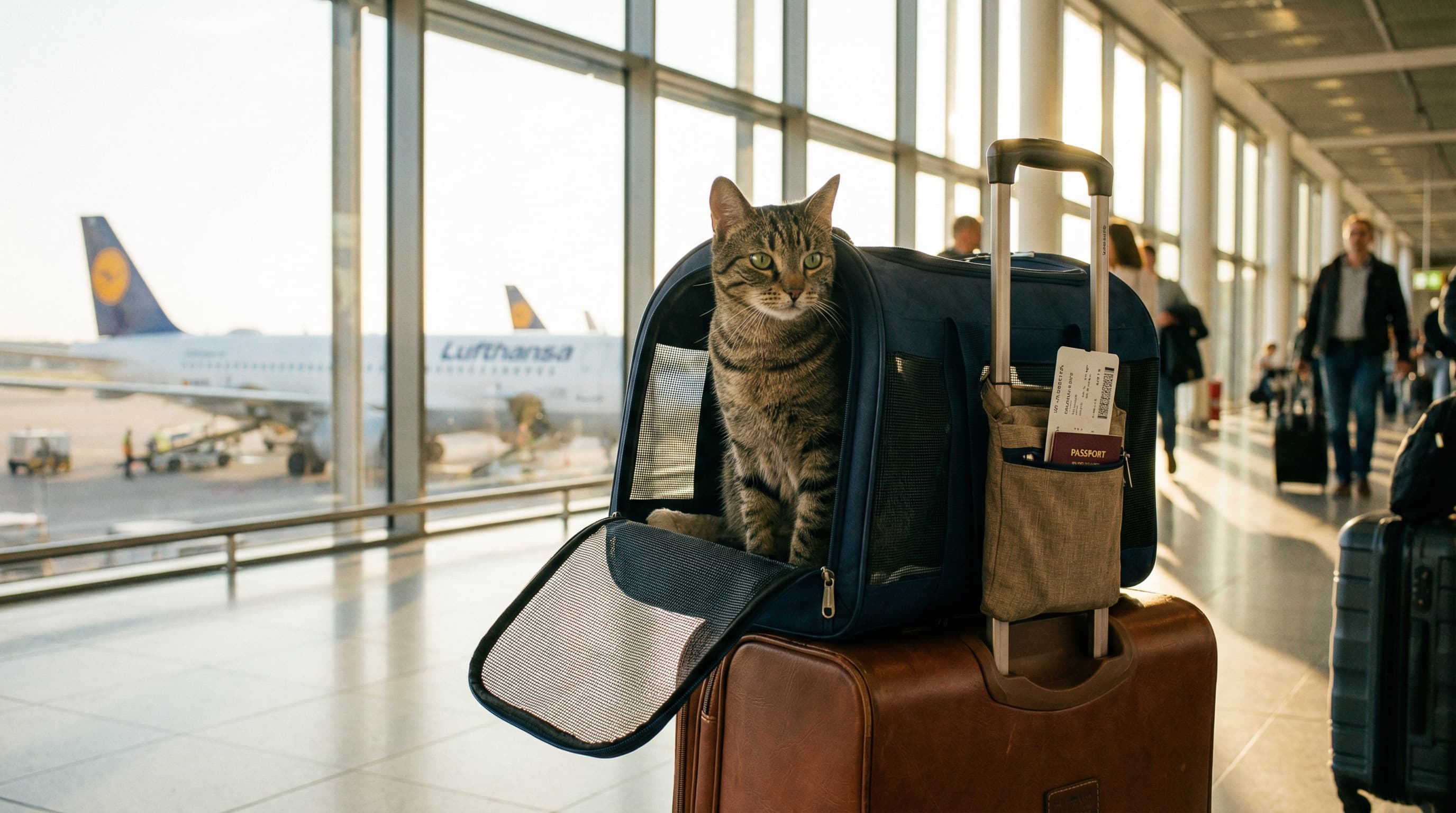
Lufthansa Pet Policy 2026: Fees, Carrier Rules & How to Book
15 min readairlines

James Harlow
Pet Relocation Consultant
| In-cabin | Yes, $120–200 each way (route-dependent) |
| Cargo hold | Yes, $200–450+ each way (crate-size dependent) |
| Lufthansa Cargo | Yes, manifest freight for oversized pets |
| Cabin carrier size | 55 × 40 × 23 cm (22" × 16" × 9") |
| Weight limit (cabin) | 8 kg / 17.6 lbs (pet + carrier combined) |
| Breed restrictions | Flat-faced breeds banned from cargo; fighting breeds need reinforced crates |
| Booking | Online or phone — 72 hours before departure |
| AirPaws rating | 2.8 / 5 |
Lufthansa takes pets in the cabin on transatlantic flights for roughly $120–200 each way. The weight limit is tight: 8 kg (17.6 lbs) total — pet and carrier combined.
Larger pets fly in the climate-controlled cargo hold at higher rates.
Two things separate Lufthansa from US carriers: a firm 72-hour advance registration deadline, and — for dogs — CDC restrictions that limit which US airports you can fly into. Cats face neither complication.
This guide covers cabin and cargo rules, carrier sizes, breed restrictions, the CDC situation for dogs, and how to book from the US.
In-Cabin Travel
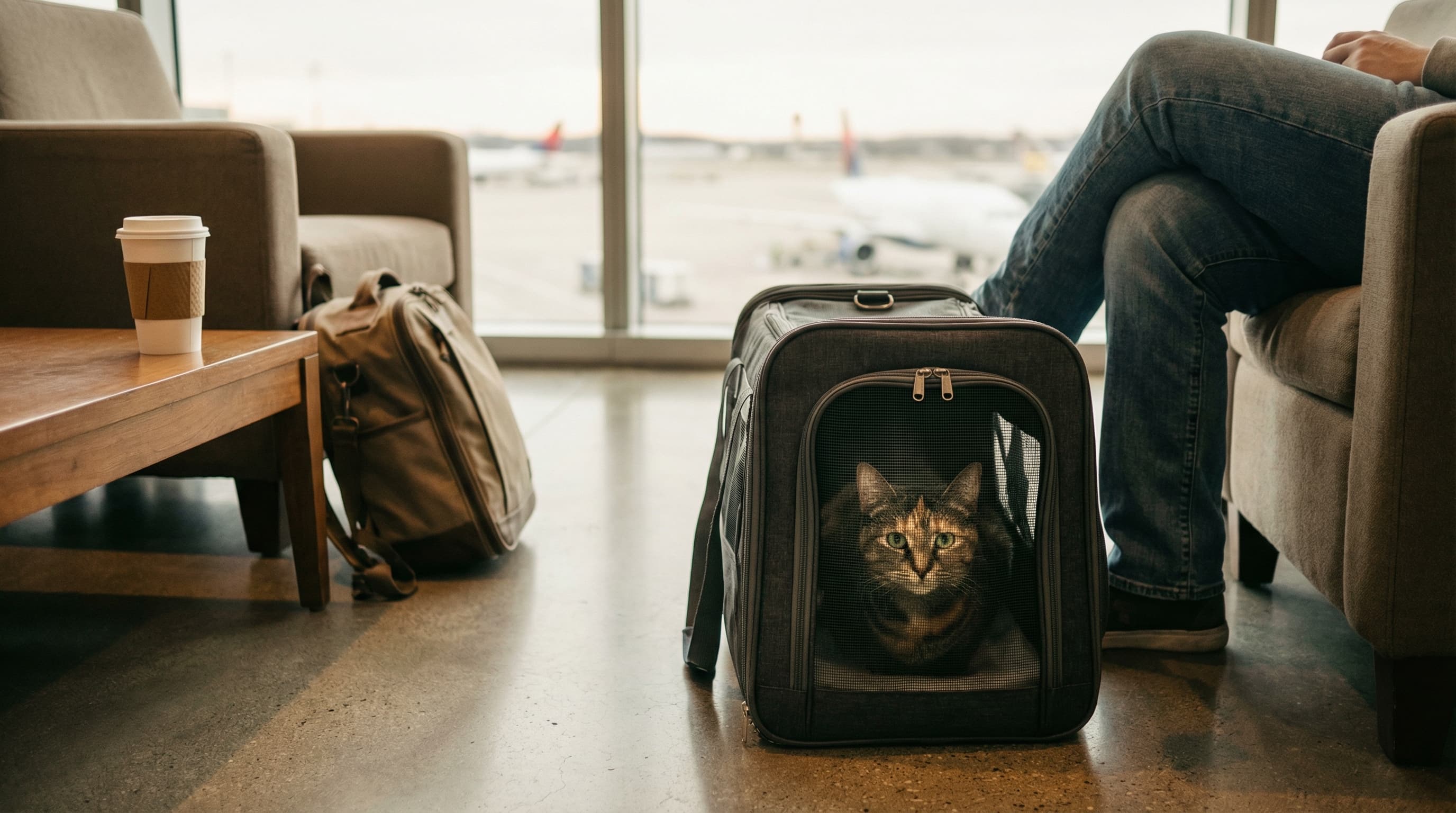
Lufthansa allows dogs and cats in the cabin as carry-on baggage. The pet plus carrier must weigh no more than 8 kg (17.6 lbs) combined — the strictest weight limit among major transatlantic carriers.
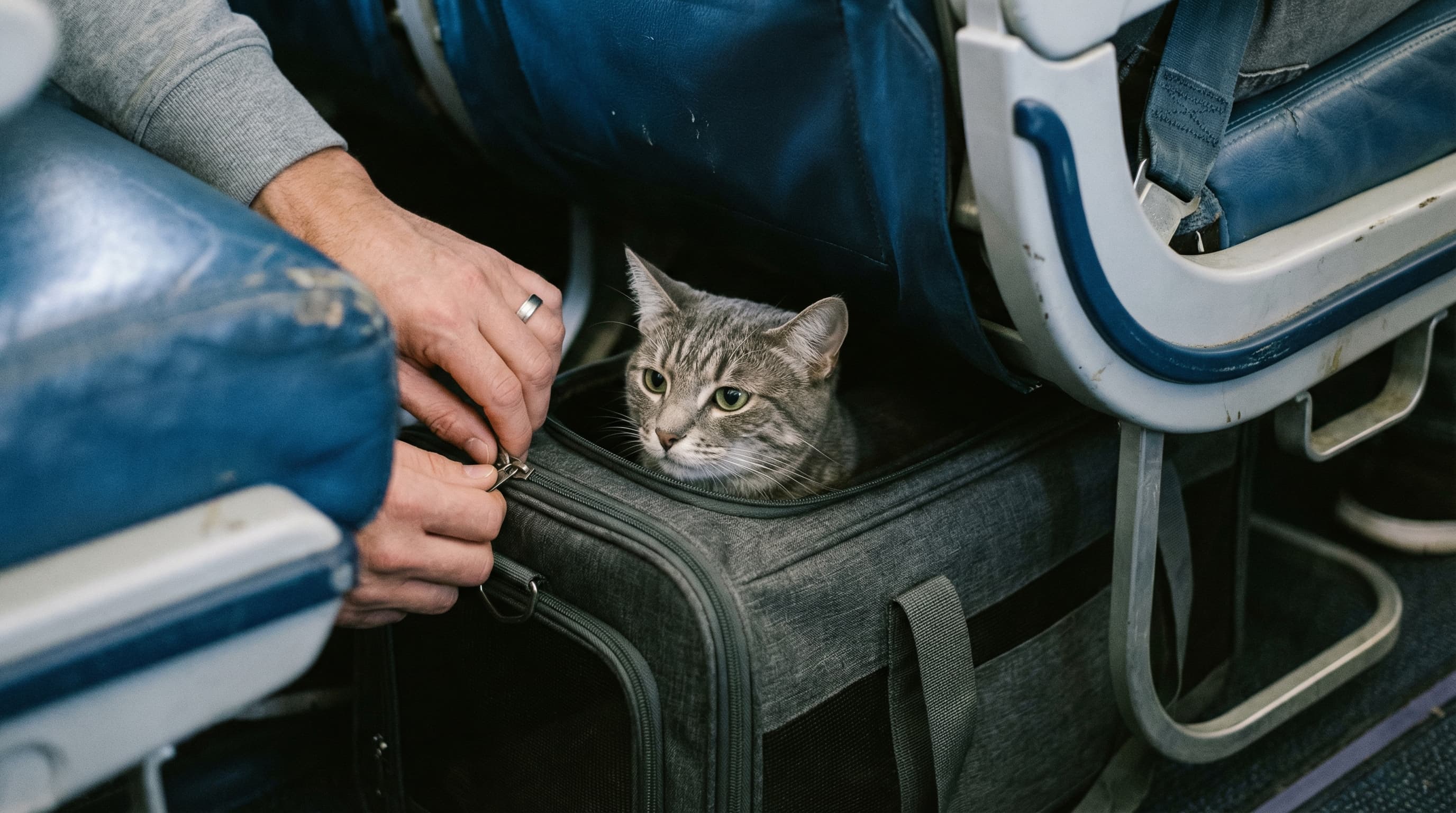
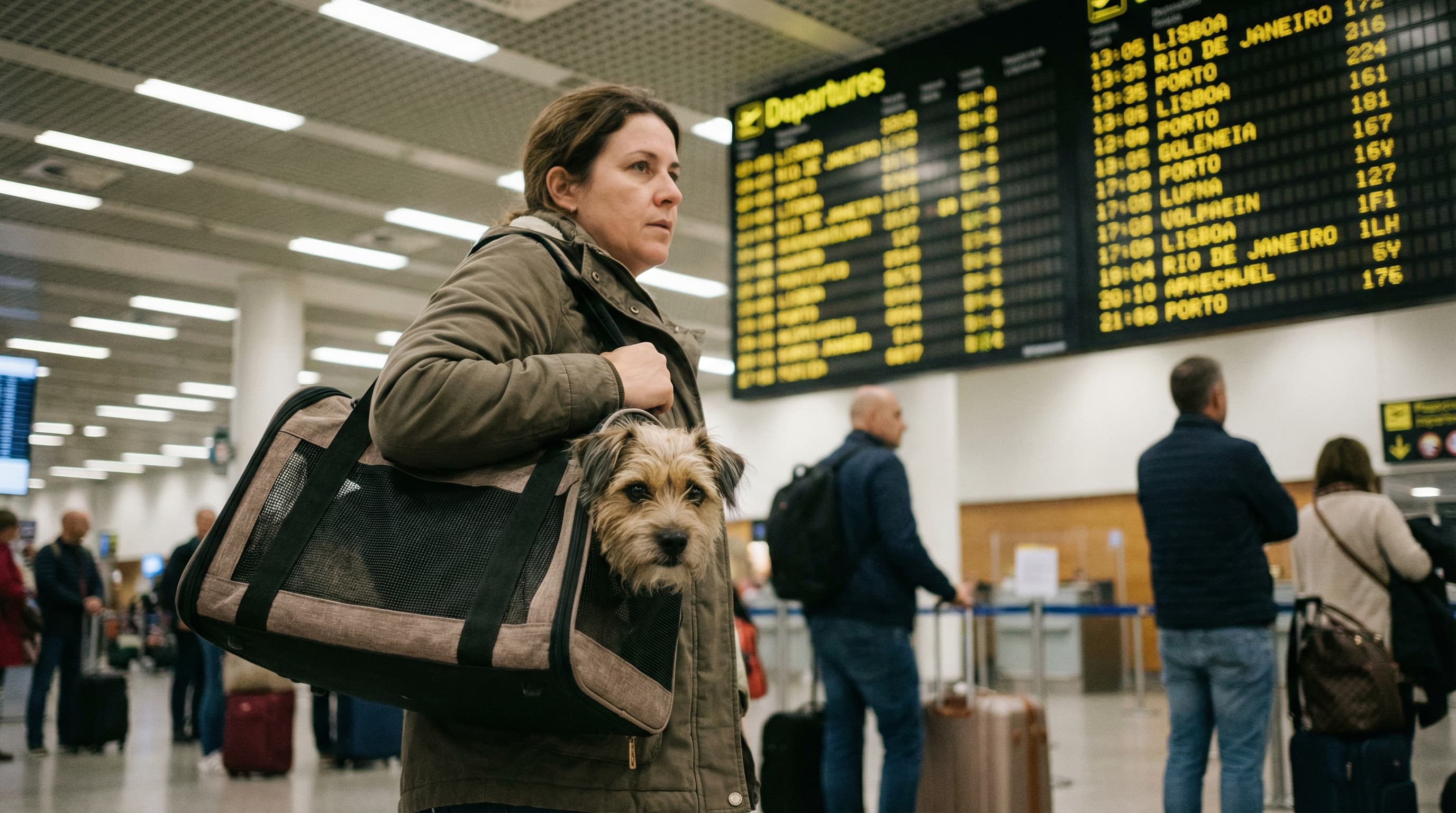
Your carrier must be soft-sided with no rigid frame, no wheels, and no telescopic handle. Maximum dimensions: 55 × 40 × 23 cm (22" × 16" × 9").
The carrier needs to be leak-proof, bite-proof, and escape-proof with ventilation on multiple sides. Line the inside with an absorbent blanket — newspaper, cardboard, and straw aren't allowed.
Bring your own carrier. They're not sold at the airport.
One carrier per passenger. Lufthansa allows two small animals to share a carrier if they're the same species, used to each other, and the combined weight including the carrier stays under 8 kg.
In-flight rules: Your pet stays in the carrier for the entire flight, stowed under the seat in front of you. If the carrier doesn't fit under the seat, the cabin crew provides a "Lufthansa Animal Belt" to secure it to your seatbelt — a feature unique to Lufthansa.
Business Class on long-haul flights: No pets. The flat-bed seat design doesn't accommodate carriers underneath. Short-haul Business Class within Europe is fine.
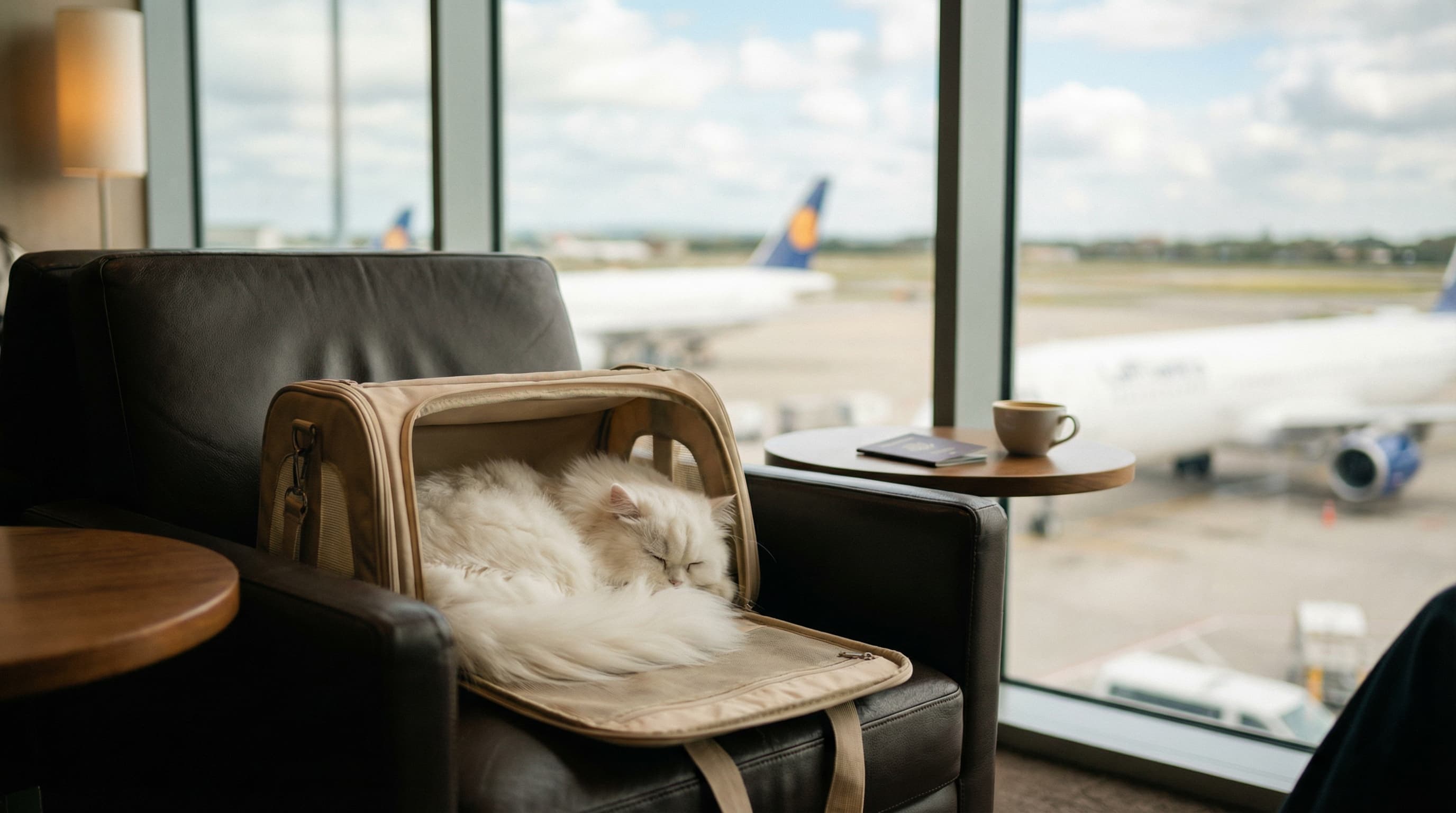
Pets in the lounge: Lufthansa is one of the few airlines that welcomes pets in their lounges. Your pet must stay in the carrier, but you can use the lounge normally while waiting for your flight.
Routes Where Cabin Pets Aren't Allowed
Lufthansa won't accept cabin pets on flights to:
- United Kingdom and Ireland (country regulations require pets to enter as cargo)
- Bangalore, India
For UK and Ireland travel, Lufthansa Cargo or another carrier may be an option.
Cabin Fees
Lufthansa doesn't publish a fixed fee table — prices come from their route-based baggage calculator. Based on route length:
| Route type | Approximate cabin fee |
|---|---|
| Within Germany | ~€55 (~$60) |
| Within Europe | ~€70–100 (~$75–110) |
| Transatlantic (US routes) | ~€110–190 (~$120–200) |
The fee covers one direction, including connecting Lufthansa flights. A round trip means paying twice.
If your itinerary has a stopover longer than 24 hours, each leg counts as a separate direction.
You pay at check-in — the fee doesn't show up in your online booking. The pet carrier doesn't count against your regular baggage allowance.
Cargo Hold Travel
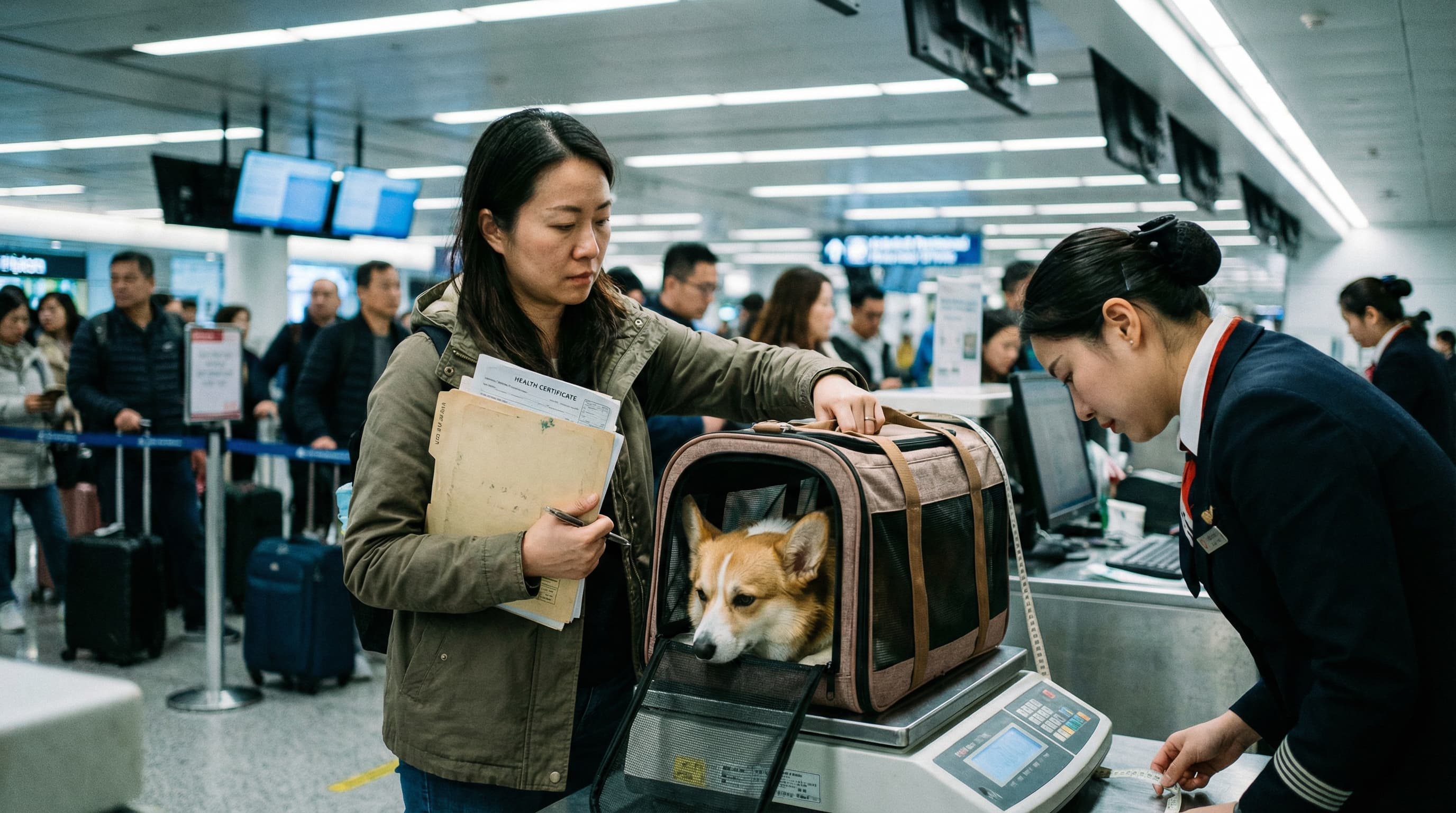
Dogs and cats over 8 kg (including crate) fly in the aircraft's climate-controlled cargo hold as "excess baggage." This is separate from Lufthansa Cargo, which handles manifest freight for oversized crates or unaccompanied pets.
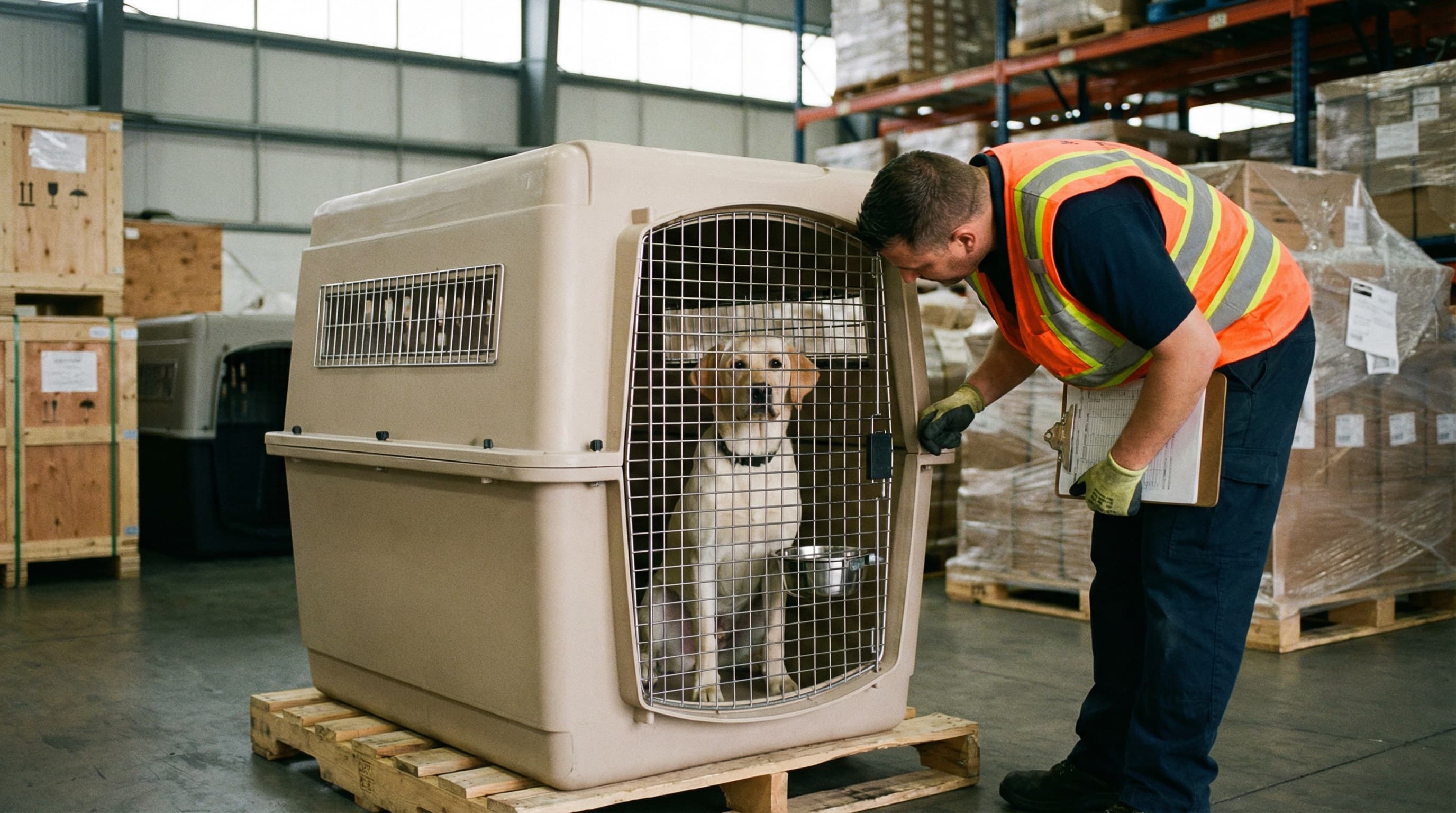
Your crate must meet IATA Live Animal Regulations standards:
- Hard-sided with metal screws securing upper and lower halves (plastic latches not accepted); no wheels
- Ventilation on all four sides — vent openings max 25 mm × 25 mm for dogs, 19 mm × 19 mm for cats
- Waterproof bottom lined with absorbent material (no newspaper, cat litter, or straw)
- Food and water dishes attached to the door, fillable from outside
- Pet must stand, turn around, and lie down in natural position
Cargo Fees
Cargo hold fees depend on your route and crate size:
| Route type | Approximate cargo fee |
|---|---|
| Within Europe | ~€100–200 |
| Transatlantic (US routes) | ~€200–400+ |
Transfer surcharges add up fast. Connecting through Brussels, Geneva, Frankfurt, Vienna, or Zurich in the cargo hold adds €150 / $170 per connection.
An overnight stay in Zurich adds another CHF 200 per crate.
Critical
Temperature Restrictions
Lufthansa restricts cargo hold transport based on destination weather:
- Above 85°F (29.4°C): Prohibited
- Below 45°F (7.2°C): Needs a veterinary acclimation certificate
- Below -6.7°C (20°F): Absolutely prohibited
These thresholds apply at the departure airport, destination, and any connection points. Summer months and deep winter can both block cargo travel.
Lufthansa Cargo (Manifest Freight)
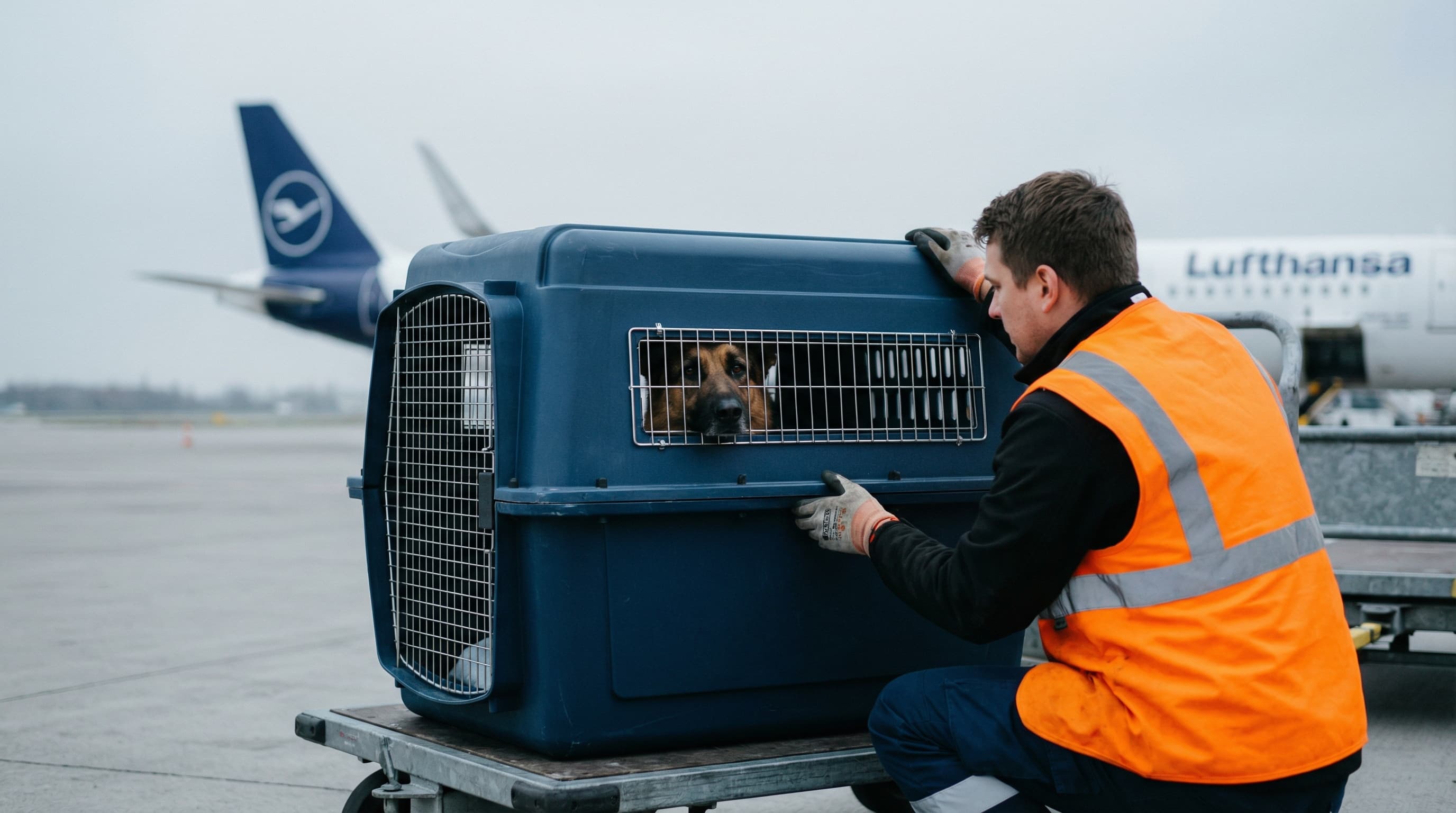
If your pet's crate exceeds 125 × 75 × 85 cm, it can't go as excess baggage — it ships as manifest freight through Lufthansa Cargo. You'll need a registered animal freight forwarder to arrange this.
Lufthansa Cargo also handles flat-faced breeds that can't fly in the regular cargo hold, and unaccompanied pets traveling without their owner.
Frankfurt Airport has a dedicated Animal Lounge where pets in cargo get comfort stops, walking breaks, and water during layovers — a genuine advantage over most carriers.
Lufthansa does not accept pets as checked baggage.
Dogs Arriving in the US: CDC Rules
Since August 1, 2024, CDC rule changes have reshaped how dogs arrive in the US on international flights. Cats are unaffected.
Lufthansa initially embargoed all new dog bookings to the US, then gradually reopened limited airports. As of late 2024, Lufthansa accepts dogs on passenger flights only to these US airports:
- Atlanta (ATL)
- Los Angeles (LAX)
- Miami (MIA)
- New York–JFK (JFK)
- Newark (EWR) — reopened October 2024, only if your dog hasn't been in a high-risk rabies area in the past 6 months
- Philadelphia (PHL)
- Washington, DC (IAD)
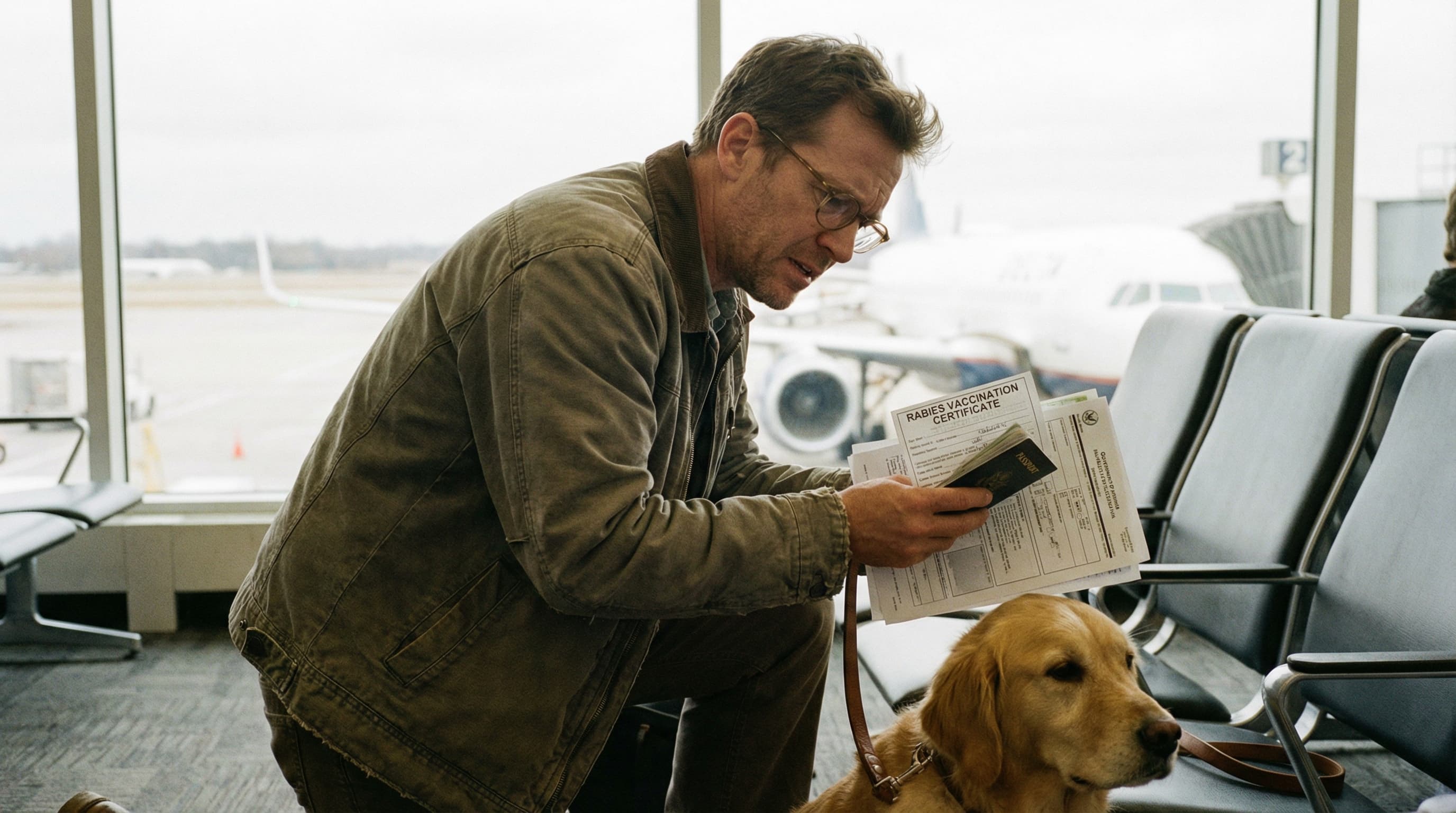
For all other US airports, dogs must travel via Lufthansa Cargo through a freight forwarder.
What you need for dogs arriving in the US:
- CDC Dog Import Form — submit online before departure. Bring the confirmation receipt (digital or printed) to check-in. Without it, Lufthansa refuses boarding.
- Dog must be at least 6 months old
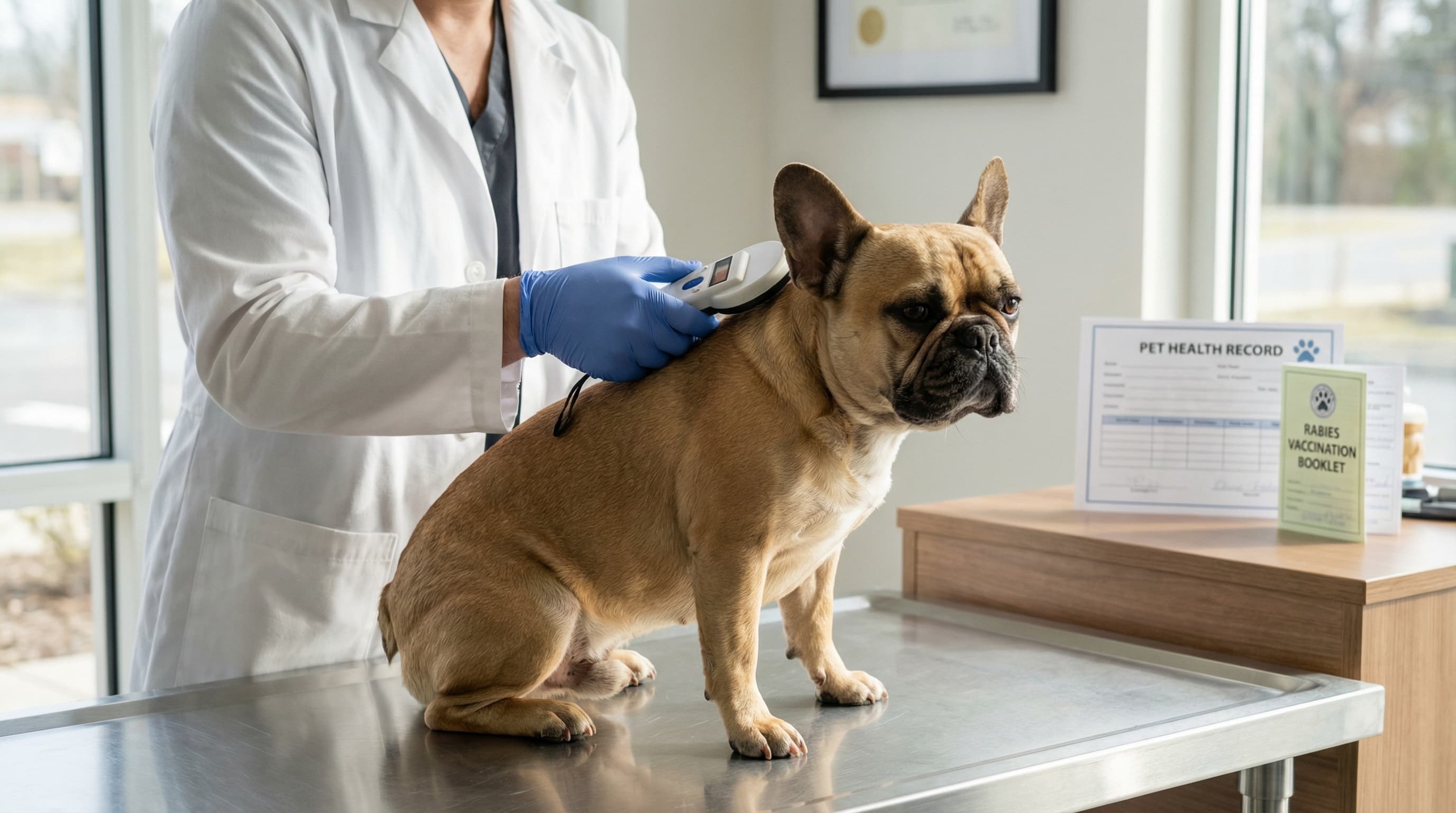
- Dog must be microchipped
- Dog must appear healthy at check-in
Cats arriving in the US from Germany have no CDC-level restrictions beyond standard airline and destination health certificates.
Breed Restrictions
Lufthansa has one of the most complex breed restriction policies of any airline. Three categories apply, and some breeds fall into multiple categories at once.
Flat-Faced (Brachycephalic) Breeds
Since January 2020, Lufthansa has banned all flat-faced breeds from the cargo hold — both dogs and cats. These breeds can still fly in the cabin if they meet the 8 kg weight limit, or ship via Lufthansa Cargo as manifest freight.
Dogs: Affenpinscher, Bulldogs (all types except American Bulldog), Pugs, Boston Terrier, Boxer, Brussels Griffon, Bull Mastiff, Bull Terrier, Chow Chow, English Toy Spaniel, Japanese Chin, King Charles Spaniel, Lhasa Apso, Pekingese, Shar Pei, Shih Tzu, Tibetan Spaniel, and their cross-breeds.
Cats: British Shorthair, Exotic Shorthair, Himalayan, Persian, Scottish Fold, and their cross-breeds.
Flat-faced breeds have compressed airways that make breathing harder under the stress and temperature swings of cargo travel. Cabin travel eliminates most of that risk.
Fighting Dog Breeds
These breeds fly in the cargo hold only and need reinforced IATA CR-82 crates — no plastic parts, heavy-duty wire mesh or metal construction throughout:
- American Bulldog
- Dogo Argentino
- Kangal (Karabash / Anatolian Shepherd)
- Caucasian Ovcharka (Caucasian Shepherd)
- Rottweiler
Exception: fighting-breed puppies aged 3–6 months can use standard transport containers.
Breeds Effectively Banned
Five breeds are classified as both fighting dogs and flat-faced — they can't go in the cargo hold (flat-faced ban) and can't fly in the cabin as adults (fighting dog rule):
- American Pit Bull Terrier
- American Staffordshire Terrier
- Staffordshire Bull Terrier
- American Bully
- Bull Terrier
Miniature Bull Terriers aren't classified under either category and fly under normal rules.
Germany Import Ban
Germany bans import of Pit Bull Terriers, American Staffordshire Terriers, Staffordshire Bull Terriers, and Bull Terriers. Export from and transit through Germany are still allowed.
Service Animals
Trained assistance dogs fly free in the cabin on Lufthansa.
On US flights: Up to 2 assistance dogs per passenger, including psychiatric service dogs. Submit the DOT Service Animal Air Transportation Form to Lufthansa's Medical Operation Center at least 48 hours before departure.
On non-US flights: One dog only. Must be individually trained for specific tasks — guide dogs, hearing dogs, seizure alert dogs, diabetic alert dogs.
Lufthansa does not accept emotional support animals on any flight.
Required Documents
What Lufthansa asks for is separate from what your destination country needs.
For cabin travel: Two signed printouts of Lufthansa's "Information for Transportation of Animals" confirmation form, presented at check-in.
For cargo hold travel: Two signed printouts of the cargo hold transport form, plus IATA-compliant crate labeling (live animal stickers, feeding instructions, "this way up" arrows).
For dogs to the US: CDC Dog Import Form Online Submission Receipt — digital or printed, presented at check-in and upon arrival.
For all international flights: Health certificate issued within 10 days of travel by a USDA-accredited vet, plus a USDA endorsement for the destination country. You'll also need your rabies vaccination records and microchip records.
Some countries need import permits — check our country guides for specifics.
Booking Process
- Register your pet at least 72 hours before departure. For US flights, use Lufthansa's online registration form — the Service Center can't handle US pet bookings. For other routes, register online via "My Bookings" or call 1-800-645-3880.
- Lufthansa confirms availability and makes the booking. Spots are limited and not guaranteed, so register early.
- Check in at the counter. Online check-in opens 30 hours before departure, but pet passengers must collect their boarding pass at the counter. Arrive 2–3 hours before departure.
- Bring your documents. Two signed copies of your transport form, plus your health certificate and vaccination records.
- Pay the pet fee at check-in. Lufthansa doesn't charge the fee during online booking — you pay at the airport counter.
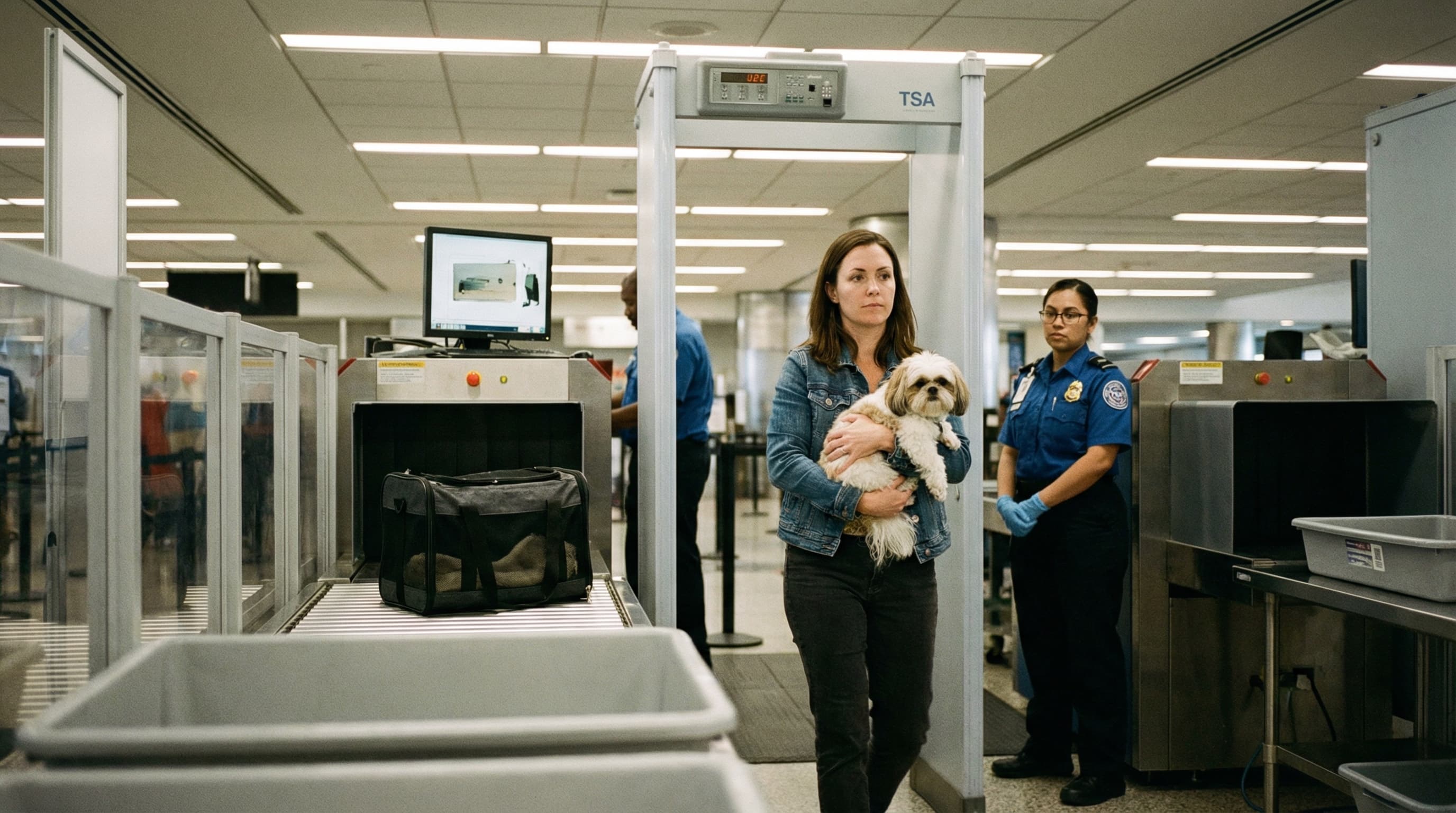
- At security: Remove your pet from the carrier, carry them through the metal detector, and send the empty carrier through the X-ray belt. Build in extra time.
TipThere's no waitlist for Lufthansa pet spots. Once the per-flight limit fills, that flight is closed to pets. Register the same day you book your ticket to lock your spot.
Common Mistakes
Tips for Flying Lufthansa with Your Pet
The Frankfurt Animal Lounge is a real advantage. If your pet connects through Frankfurt in cargo, they get a staffed facility with walking areas, water stations, and comfort breaks. Most airlines leave your pet's crate in a holding area. Route through Frankfurt when you can.
Cabin fees cover the full direction, including connections. Flying New York via Frankfurt to Munich is one charge — not two. The fee only doubles on the return trip.
Cats have it easier than dogs for US arrivals. The CDC restrictions don't apply to cats. No limited airport list, no CDC Dog Import Form, no 6-month age minimum. If you're bringing a cat back from Europe, Lufthansa works like any other airline.
Lufthansa Group airlines have separate policies. Lufthansa operates alongside SWISS, Austrian Airlines, Brussels Airlines, and Eurowings. If your booking includes a leg operated by a partner carrier, that carrier's pet rules apply to that leg — not Lufthansa's. Confirm pet acceptance with every operating airline on your itinerary.
How Lufthansa Compares
For US travelers flying to Europe with pets, here's how Lufthansa stacks up against the other major transatlantic options:
| Lufthansa | Delta | United | |
|---|---|---|---|
| Cabin fee (transatlantic) | ~$120–200 | $200 | $150 |
| Carrier size | 22"×16"×9" | 18"×11"×11" | 18"×11"×11" |
| Weight limit (cabin) | 17.6 lbs | None stated | None stated |
| Cargo | Yes | Suspended (civilian) | Yes (PetSafe) |
| Lounge access | Yes | No | No |
| Rating | 2.8 | 2.8 | 3.5 |
Lufthansa's cabin carrier is notably larger than Delta's or United's — nearly 4 inches longer and 5 inches wider. The trade-off is the 8 kg combined weight limit, which Delta doesn't enforce.
United's PetSafe cargo program is more accessible than Lufthansa's CDC-restricted cargo for dogs arriving in the US.
FAQ
Your next step: Register your pet with Lufthansa the same day you book your ticket — the 72-hour deadline is the bottleneck, and transatlantic pet spots fill quietly with no waitlist.