If your pet's rabies vaccination has lapsed — even by a day — the next vaccination counts as a primary. That resets the 6-month clock. Check your pet's vaccination records now, not when you start the import process.
Bringing a Dog or Cat to New Zealand from the US — 2026 Requirements
24 min readinternational

Dr. Sarah Chen
Travel Veterinarian
| Applies to | Dogs and cats (dogs need extra blood tests) |
| Documents | Import permit + OVD + health certificates A & B + USDA endorsement + lab reports + quarantine booking confirmation |
| Vaccines | Rabies (inactivated virus only). 6-month wait if first vaccination |
| Titer test | FAVN or RFFIT, ≥0.5 IU/ml, 90-day wait from blood draw |
| Microchip | Required (ISO microchip or AVID 9/10 chip). Must be implanted before rabies vaccine |
| Quarantine | 10 days minimum at MPI-approved facility |
| Arrival | Auckland or Christchurch only. Manifest cargo only |
| Cost | $3,500–$15,000+ (dogs) / $3,000–$12,000+ (cats) |
| Timeline | Start 6–8 months before travel |
| Difficulty | 🔴 Very Hard |
Bringing your dog or cat to New Zealand from the US costs $3,000–15,000+ and takes a minimum of 6 months.
New Zealand classifies the US as a Category 3 country (rabies absent or well-controlled), which means the most complex import process.
MPI (New Zealand's Ministry for Primary Industries) runs one of the strictest pet import systems in the world: ISO microchip, rabies vaccination with a 6-month wait for first-time vaccines, a titer test with a 90-day holding period, an import permit taking 30 working days to process, mandatory 10-day quarantine, and manifest cargo transport into Auckland or Christchurch only.
Dogs need three extra blood tests that cats skip entirely. This guide covers every step, cost, and deadline for both species.
What You Need
Rules for both dogs and cats:
- ISO microchip (or AVID 9/10 chip), implanted before any rabies vaccination or blood tests. Microchip number must appear on every document.
- Minimum Age: Dogs must be at least 9 months old at the time of shipment to enter New Zealand from the USA.
- Rabies vaccination (inactivated/killed virus only) given after microchip implantation. First-time vaccination: must be given at least 6 months before export. Booster: must be active and not lapsed.
- Rabies titer test (FAVN or RFFIT) showing ≥0.5 IU/ml. Blood drawn 3–4 weeks after vaccination. 90-day mandatory wait from the date the lab receives the sample
- Official Vet Declaration (OVD) — MPI's specific form, signed by your registered vet and an official government vet, stamped
- Two health certificates: Certificate A from a USDA-accredited vet, Certificate B endorsed by USDA APHIS with original ink stamp and embossment
- Two rounds each of external (flea and tick) and internal (worm) parasite treatments on MPI's schedule
- Import permit from MPI's APIPS portal — requires confirmed quarantine booking before you can apply. 30 working days to process
- Canine influenza declaration: your pet must not have been kept with animals showing respiratory illness signs for 21 days before shipment
- Arrival as manifest cargo at Auckland (AKL) or Christchurch (CHC) only
Dogs from the US Also Need
- Brucella canis test — at least 16 days before travel. Accepted tests: RSAT, TAT, CPAg-AGID, or IFAT. A positive result permanently bars entry — no treatment, no retesting, no exceptions
- Babesia gibsoni test — within 16 days of travel. IFAT or ELISA, or two negative PCR tests 30–37 days apart. Positive result permanently bars entry
- Leptospirosis — either 14 consecutive days of doxycycline treatment or a negative MAT test within 30 days of travel
- Breed declaration form as part of the import permit application
Cats skip all four of those. The blood work difference alone saves cat owners about $500–800 and several vet visits.
Critical
Rabies Vaccine and Titer Test
The rabies vaccine and titer test are the biggest bottleneck. Two separate waiting periods stack on top of each other, and getting them wrong means starting over.
Rabies Vaccination Timing
Your pet needs an inactivated (killed virus) rabies vaccine given after microchip implantation. If this is your pet's first rabies shot, MPI requires it to be given at least 6 months and no more than 12 months before export.
If your pet has active boosters that haven't lapsed, you only need the two most recent vaccination records — no 6-month wait.
The catch: if the previous vaccination has lapsed, MPI treats the new one as a primary vaccination. That triggers the full 6-month wait. This catches people who got their pet vaccinated years ago but let it lapse before starting the NZ process.
Titer Test Process
- Wait 3–4 weeks after the rabies vaccine for antibodies to build
- Your vet draws blood, records the microchip number on the sample and lab submission form
- Blood goes to a government-approved lab for FAVN or RFFIT testing. In the US, Kansas State University (KSU) is the most common choice — about $79–90 per sample
- Result must show ≥0.5 IU/ml. Below that means revaccinate, wait 3–4 weeks, and retest
- The 90-day mandatory wait starts from the date the lab receives the blood sample — not when you get results back
- The titer test is valid for 3 months from the blood draw date. If your travel date slips past 3 months, you repeat the test
Total cost through your vet including blood draw, serum prep, and overnight cold-chain shipping to the lab: $300–700. Results take 2–3 weeks.
Make sure your vet understands the sample is for travel overseas. The lab test for international export is different from domestic rabies testing. Using the wrong test means repeating the blood draw and restarting the 90-day clock.
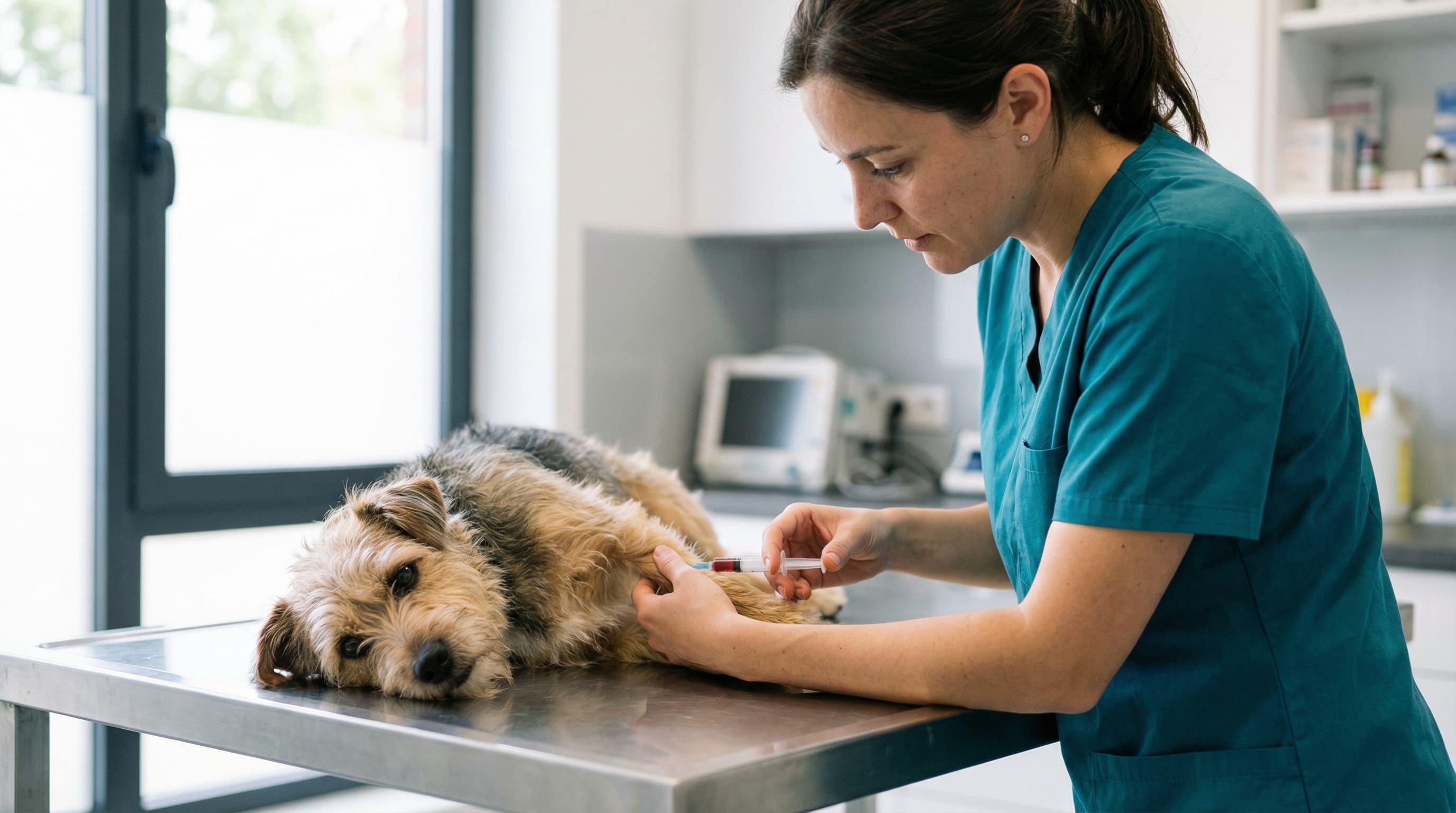
Dog-Specific Blood Tests
Dogs face three extra tests that can permanently block entry if they come back positive. Get these done on time — the testing windows are strict.
Brucella canis — test at least 16 days before travel. Approved methods: RSAT, TAT, CPAg-AGID, or IFAT. NZ no longer accepts the 2ME-RSAT as a standalone test (changed in 2024). Desexed (neutered/spayed) dogs are now exempt from this test.
A positive result means your dog cannot enter New Zealand, period. There is no treatment that NZ will accept.
Babesia gibsoni — test within 16 days of travel. Approved methods: IFAT or ELISA.
Alternative path: two PCR tests with negative results on samples collected 30–37 days apart, with the second sample drawn within 16 days of shipment. A positive result is also a permanent bar.
Leptospirosis — two options: complete a 14-day course of doxycycline within 30 days of travel, or get a negative MAT (microscopic agglutination test) within 30 days.
The Brucella and Babesia results are the highest-stakes tests in this entire process. If your dog tests positive for either one, there is no appeal, no treatment option, and no retesting pathway that NZ will accept.
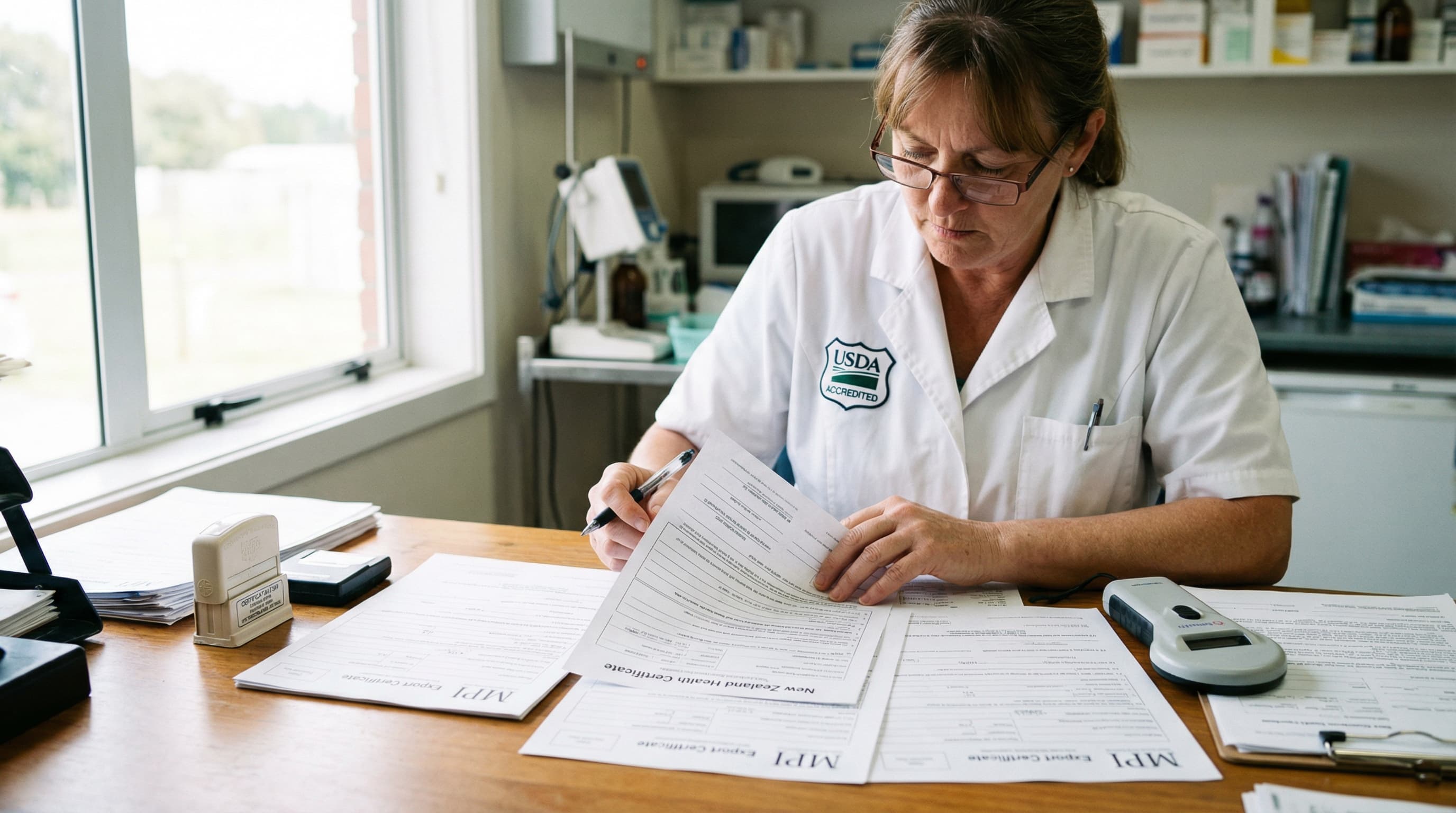
Health Certificate and USDA Endorsement
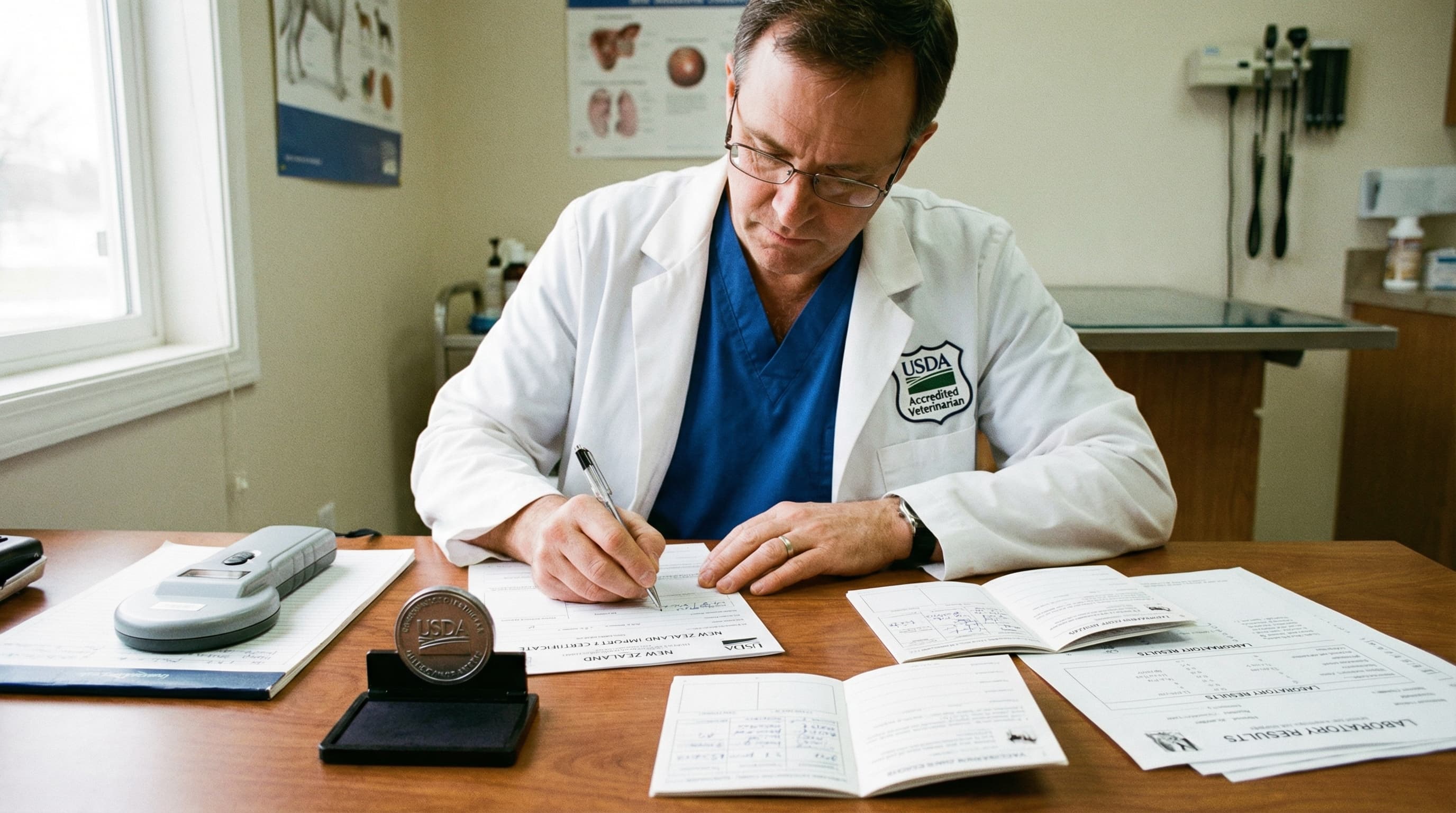
New Zealand requires more paperwork than most countries. You need three documents working together: the OVD, Health Certificate A, and Health Certificate B.
Official Vet Declaration (OVD): This is MPI's own form — not the standard APHIS 7001. Your registered vet fills it out, then a USDA veterinary medical officer reviews, signs, and stamps it.
The OVD ties together your pet's microchip, vaccination history, and titer test results into one verified document. Download the current OVD form from MPI. Using an outdated version can delay your permit.
Health Certificate A: Completed by a USDA-accredited vet using MPI's model veterinary certificate for Category 3 countries. Your vet examines your pet and certifies it meets NZ's import health requirements. Not every vet holds this accreditation — find one near you.
Health Certificate B: USDA APHIS endorses the health certificate with an original ink signature and embossed stamp. Electronic endorsement alone is not accepted — NZ wants the physical stamp.
Submit through the VEHCS (Veterinary Export Health Certification System). Processing takes 2–3 business days by mail, same-day if you go in person to a USDA office.
Original lab reports (or APHIS-endorsed copies) for every blood test must travel with your pet. Each report needs the microchip number, sample collection date, test type, and result.
Watch OutThe vet exam and health certificate timing is tight. Schedule the vet visit within the final days before export — but factor in that you also need USDA endorsement after the vet visit. Work backward from your flight date and build in at least 2 days of buffer.
Microchip
Your pet needs an ISO 11784/11785 microchip. NZ also currently accepts AVID 9-digit and 10-digit chips.
The microchip must be implanted before any rabies vaccination used for the import process. If you vaccinate first and chip later, the vaccination doesn't count — you revaccinate and restart the timeline.
The microchip number appears on every single document in this process: the OVD, both health certificates, every lab report, the import permit application, and the quarantine booking.
Airport officials scan your pet at arrival to match the chip to the paperwork. If the numbers don't match, your pet goes into extended quarantine while MPI sorts it out.
Cost: $25–50 at most US vets. If your pet already has an ISO-compatible chip, you're set — just confirm the number matches all your records.
Import Permit
Every pet entering New Zealand from the US needs an import permit from MPI. This is not optional, and it takes longer than most people expect.
How to apply: Through MPI's APIPS (Animal and Plant Import Permit System) online portal. You'll upload paperwork including the OVD, titer test results, vaccination records, and quarantine booking confirmation. MPI recommends Chrome as the browser.
Before you apply: You must have a confirmed quarantine facility booking. MPI won't process the permit without it. Dogs also need a breed declaration form.
Processing time: 30 working days from the date all documentation is complete and correct. MPI extended this from 20 days in August 2024. If anything in your application is missing or incorrect, the 30 days resets when you resubmit — and you may be charged again.
Cost: NZD $233.25 excluding GST (NZD $268.24 including GST). If processing takes longer than 1.5 hours, MPI charges an hourly rate of NZD $178.83 including GST for the extra time.
If your dates change: Contact the quarantine facility first to confirm new dates. Then email MPI's animal imports team with your current permit (or reference ID) and updated quarantine booking. If the new dates fall outside your permit's validity, you need a new permit at full cost.
Seasonal warning: MPI has annual processing shutdowns around the holidays. Permit applications submitted after early November may not be processed until late February. If you're planning a move in January or February, apply by October at the latest.
Quarantine
Every pet from the US spends a minimum of 10 days in quarantine after arriving in New Zealand. There are no exceptions, no expedited options, and no way to quarantine at home.
Facilities: Five MPI-approved quarantine facilities operate in New Zealand:
| Facility | Location | Accepts |
|---|---|---|
| Avondale | Auckland | Cats only |
| Takanini | Auckland | Dogs and cats |
| Pokeno | South of Auckland | Dogs and cats |
| Levin | North of Wellington | Dogs and cats |
| Aylesbury (Canterbury Quarantine Services) | West of Christchurch | Dogs and cats |
All facilities are privately owned and operated. Pricing, conditions, and services vary. Some allow visits during quarantine, others don't. Some accommodate special diets and medications. Contact facilities directly for current pricing — MPI doesn't publish or regulate their rates.
Cost: Roughly NZD $1,000–2,000+ for 10 days depending on the facility, pet size, and services. Larger dogs cost more. Special requirements (medication administration, special diet) add to the bill.
What can extend quarantine: Incomplete paperwork, unresolved health issues, or parasite treatment needed on arrival can extend quarantine to 30 or even 60 days. Each extra day costs more. Getting your documents right the first time is the cheapest thing you can do in this entire process.
Book early. Facilities have limited capacity, and space fills up — especially at Auckland facilities, which handle the majority of arrivals.
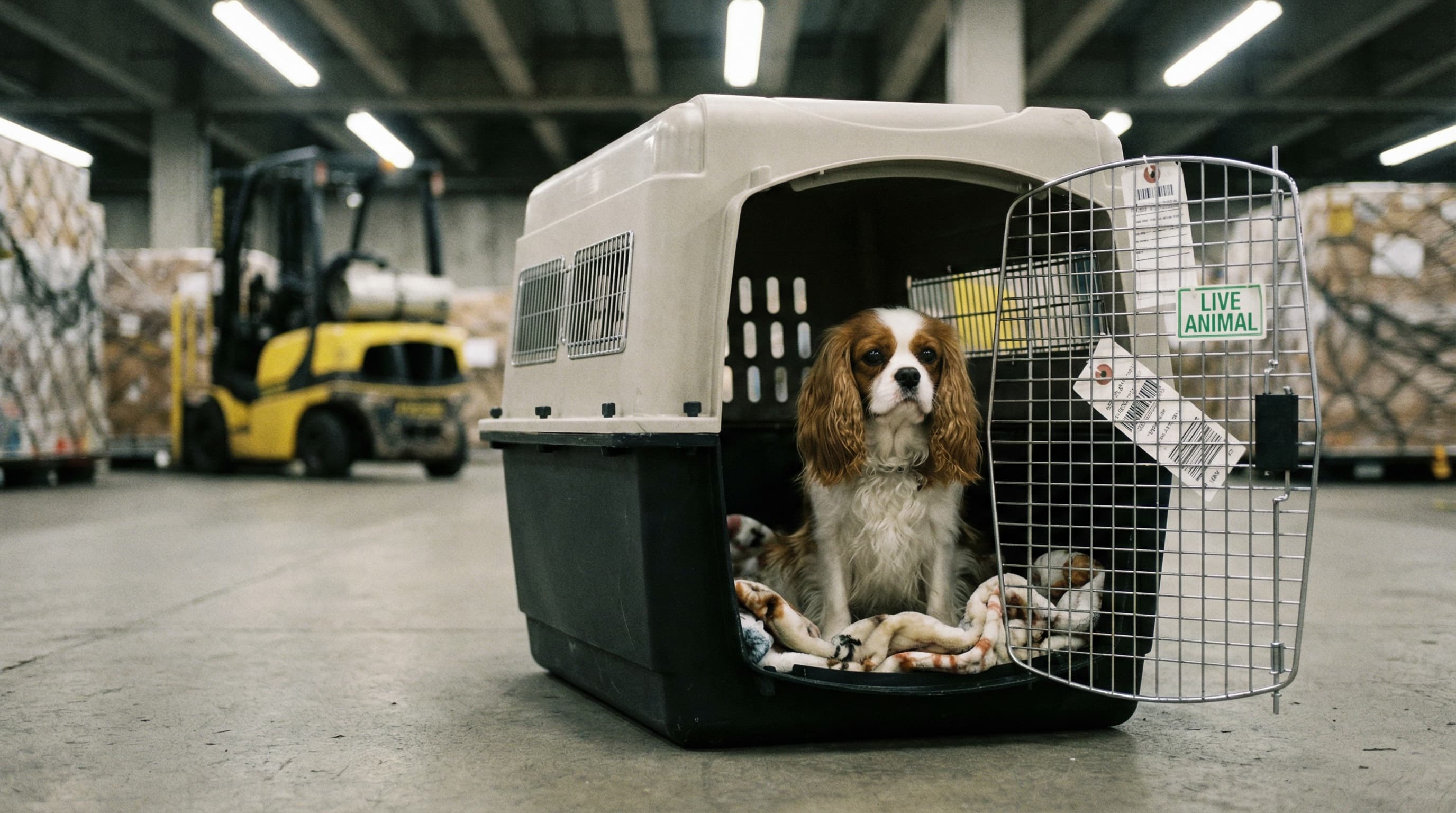
Airline Rules for Flying Pets to New Zealand
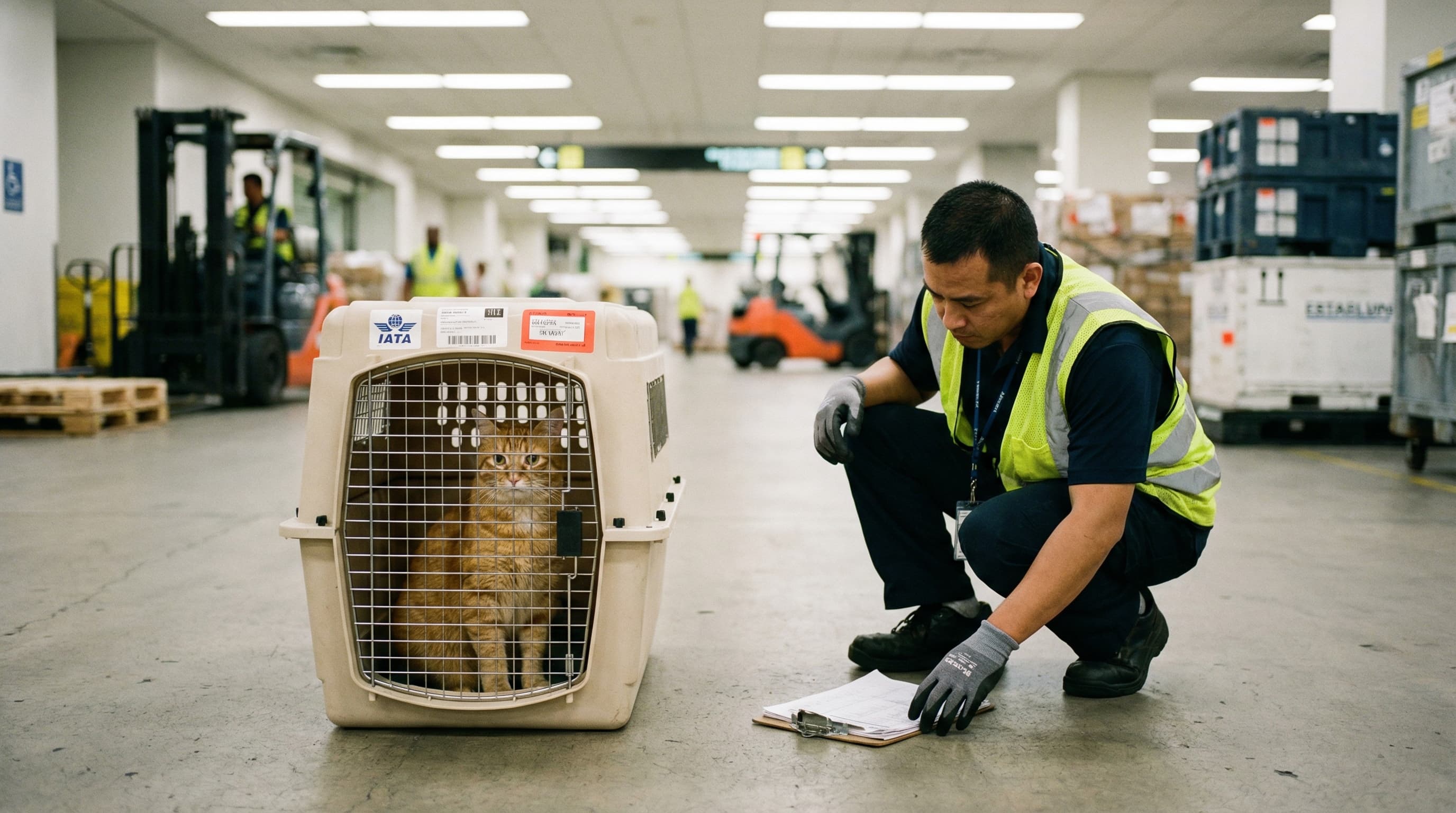
No airline allows pets in the cabin on flights from the US to New Zealand. These are 12–17+ hour flights. Every pet travels as manifest cargo in a pressurized, temperature-controlled hold.
Air New Zealand is the primary carrier for US-to-NZ pet transport. Direct routes from LAX, SFO, IAH (Houston), and HNL (Honolulu) to Auckland. Key rules:
- Air NZ does not accept direct pet bookings from the public. You must use an approved pet transporter
- Pets presented to Air NZ Cargo at least 3 hours before departure (4 hours for flights with extra security)
- IATA-compliant crates required with MPI-endorsed stamp where applicable
- No sedation — MPI prohibits sedation for any pet traveling by air from NZ, and Air NZ won't accept sedated animals on inbound flights either
- Blanket with a familiar scent is OK in the crate. No food, toys, sharp objects, or bean bags
- Racing or breeding greyhounds are prohibited. Pet greyhounds need special approval with 12 months of proof as a domestic pet
Qantas is an alternative via Australia, but connecting through Australia adds complexity — your pet would need to clear Australian biosecurity requirements too, making the process significantly harder.
United Airlines suspended its PetSafe cargo program and does not offer general pet cargo to NZ.
Flat-faced breeds: Air NZ bans all brachycephalic dogs and cats on flights over 5 hours. Every US-to-NZ route exceeds 5 hours. This means pugs, bulldogs, Boston terriers, boxers, Shih Tzus, Persian cats, Burmese, and Himalayans cannot fly Air NZ to New Zealand at all.
If your pet is a flat-faced breed, finding transport to NZ will be extremely difficult. Contact a specialized pet transport company to explore options.
Temperature embargoes: NZ seasons are reversed from the US. Flying in US winter (December–February) means arriving in NZ summer — heat embargoes may apply if ground temperatures exceed 29°C (84°F). LAX and Honolulu departures tend to have the most favorable year-round temperatures.
For airline fee comparisons across carriers, see the airline pet fee comparison.
Cost Breakdown
New Zealand is one of the most expensive destinations for pet travel. The process involves multiple vet visits, specialized blood tests, government fees on both ends, air freight, and 10 days of quarantine.
Dogs
| Vet visits (5+ appointments) | $800–$1,500 | Exam, microchip, vaccines, blood draws, certificates |
| Rabies titer test (lab + shipping) | $300–$700 | KSU lab: ~$79–90 per sample + vet and shipping fees |
| Brucella canis test | $50–$150 | Required for dogs only |
| Babesia gibsoni test | $100–$200 | IFAT/ELISA, or two PCR tests |
| Leptospirosis (doxycycline or MAT) | $50–$150 | 14-day course or single test |
| USDA endorsement | $38+ | First pet; extra pets less |
| MPI import permit | ~$160–$210 | NZD $268.24 incl GST |
| MPI border inspection | ~$225–$350 | NZD $374.05 first pet; $124.68 each additional |
| Air freight (cargo) | $1,000–$4,500 | Based on crate dimensions; larger dogs cost more |
| Quarantine (10 days) | $600–$1,200+ | Varies by facility and dog size |
| Pet transport company (optional) | $2,000–$6,000 | Full-service handling end to end |
| Total (DIY, small dog) | $3,500–$6,000 | |
| Total (DIY, large dog) | $5,000–$9,000+ | |
| Total (full-service transport) | $7,000–$15,000+ |
Cats
| Vet visits (3–4 appointments) | $400–$800 | Fewer tests than dogs |
| Rabies titer test (lab + shipping) | $300–$700 | Same test as dogs |
| USDA endorsement | $38+ | First pet |
| MPI import permit | ~$160–$210 | Same as dogs |
| MPI border inspection | ~$225–$350 | Same fee schedule |
| Air freight (cargo) | $1,000–$2,000 | Smaller crate = lower freight cost |
| Quarantine (10 days) | $600–$1,200 | Varies by facility |
| Pet transport company (optional) | $1,500–$4,000 | Full-service |
| Total (DIY) | $3,000–$5,500 | |
| Total (full-service transport) | $5,000–$12,000+ |
The biggest single cost is air freight, which is priced by crate dimensions (not pet weight). A Great Dane's crate costs 3–4x what a cat carrier costs to ship.

Timeline
New Zealand's process has multiple dependencies that must happen in the right order. Working backward from your travel date:
6–8 months before: Get your pet microchipped (if not already done). Get the rabies vaccine — if it's a first-time vaccination or the previous one has lapsed, the 6-month clock starts here. If your pet has active rabies boosters, confirm they won't expire before your travel date.
5–6 months before: Rabies titer blood draw (3–4 weeks after vaccination). The lab sends results in 2–3 weeks. The 90-day wait starts when the lab receives the sample. Start researching quarantine facilities and pet transport companies.
3–4 months before: Book your quarantine facility. Apply for the MPI import permit through APIPS — you need the quarantine booking confirmation to apply. Processing takes 30 working days from a complete, correct application. Allow 8 weeks total to be safe.
1 month before: Begin first round of parasite treatments (external and internal). If your dog needs leptospirosis treatment, start the 14-day doxycycline course.
16–26 days before: Brucella canis test for dogs (at least 16 days before travel; the 10-day extension may allow up to 26 days). Babesia gibsoni test for dogs (within 16 days, or 26 with extension). Second Babesia PCR if using the two-test pathway.
4 days before: Second internal parasite treatment (nematodes and cestodes).
2 days before: Second external parasite treatment (fleas and ticks). Vet exam for Health Certificates A and B.
Final days: USDA APHIS endorsement of Health Certificate B (same-day in person, 2–3 days by mail). Submit canine influenza declaration if your vet certificate doesn't include the clause.
72 hours before arrival: Contact MPI to arrange the veterinary inspection at the airport.
For dogs returning to the US: Complete the CDC Certification of US-issued Rabies Vaccination form with a USDA-accredited vet before you leave the US. This form cannot be issued retroactively. Read the returning to the US section before booking anything.

Common Mistakes
Airport Tips
Your pet arrives at Auckland or Christchurch as manifest cargo. You will not see your pet at the airport — the pet goes directly from the aircraft to the quarantine facility.
What happens on arrival: An MPI biosecurity inspector meets the shipment. A veterinary inspector examines your pet and reviews all the paperwork. If everything checks out, the pet is transported to the quarantine facility you booked.
You'll be charged for both the biosecurity and veterinary inspections (NZD $374.05 for the first pet, $124.68 for each extra pet).
What can go wrong: If paperwork is missing, incorrect, or the microchip doesn't match, your pet may face extended quarantine (up to 30–60 days) while MPI resolves the issues — at your cost.
If your pet has fleas or ticks on arrival, they'll be treated and the quarantine clock may restart. Bring every original document and every lab report. Have copies as backup, but MPI checks originals.
Visiting during quarantine: Policies vary by facility. Some allow visits during quarantine, others don't. Ask when you book. The 10-day quarantine goes faster for your pet with familiar-scented bedding — put a blanket in the crate that smells like home.
Collecting your pet: After the quarantine period, the facility contacts you (or your pet transport company) for pickup. You'll need government-issued photo ID. If you're not yet in NZ when your pet clears quarantine, coordinate with a friend or your transport company.
Re-entry to the USA
If you're moving to NZ permanently, skip this section. If you might return to the US with your pet, read this before you leave — especially for dogs.
Dogs
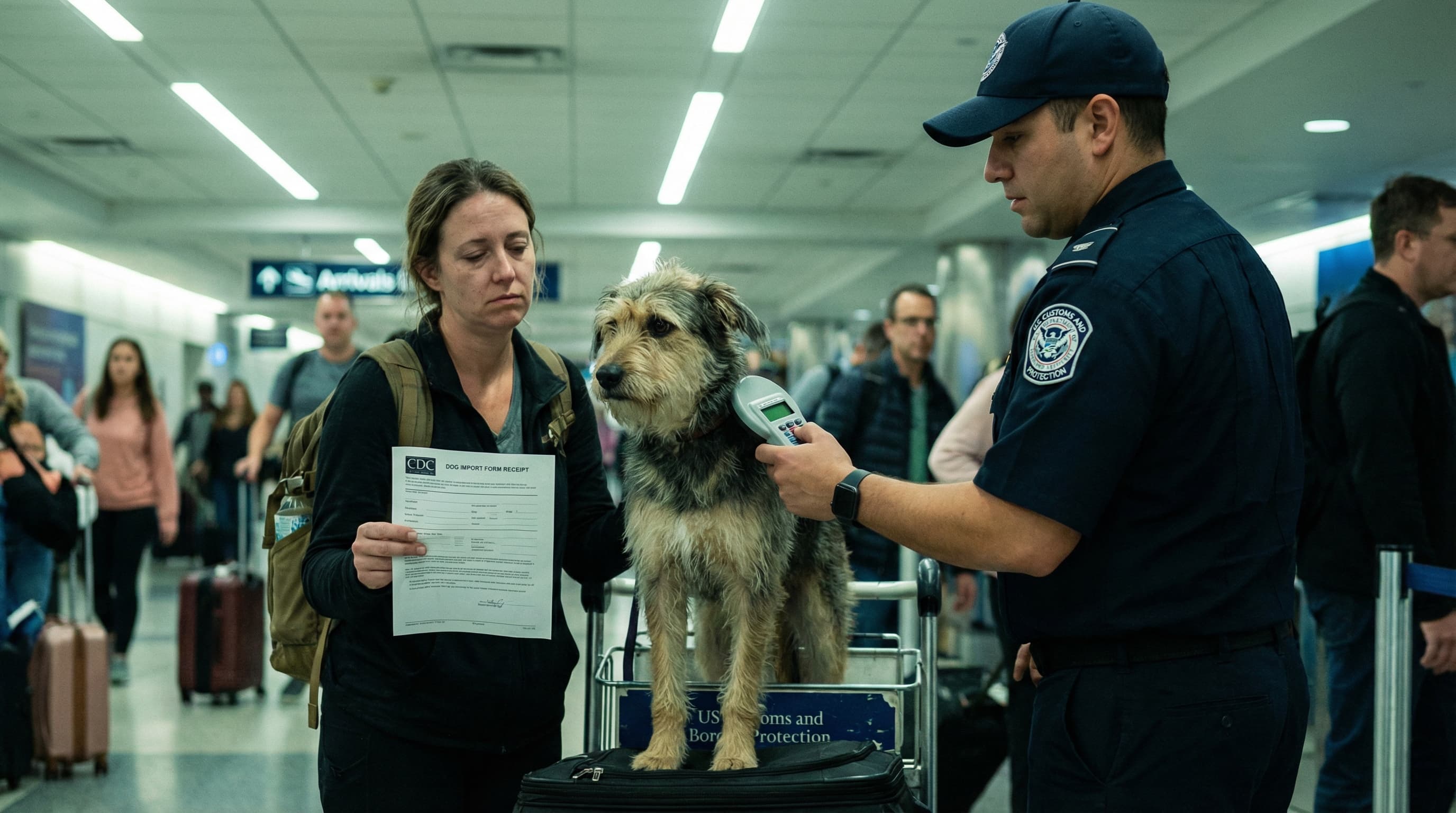
CDC rules changed significantly in August 2025. Dogs returning to the US now need:
- CDC Dog Import Form — fill out online before travel, print the receipt
- Certification of US-issued Rabies Vaccination form — this specific form must be completed by a USDA-accredited vet before you leave the US. It cannot be completed retroactively from overseas. The form is valid for multiple re-entries as long as the rabies vaccination hasn't expired
- Dog must be at least 6 months old
- Microchip readable by a universal scanner
- Dog must appear healthy on arrival
The Certification of US-issued Rabies Vaccination form is the critical one. If you leave the US without it, getting your dog back in becomes significantly harder. Add this to your pre-departure checklist alongside the NZ paperwork.
New Zealand is not in a CDC high-risk rabies country category, so you won't need the more complex re-entry process reserved for high-risk countries. But you still need the form.
Cats
Cats have a simpler re-entry:
- Must appear healthy on arrival — that's the main federal requirement
- No CDC import form needed
- No federal microchip requirement
- No rabies vaccination proof required by CDC
State requirements may apply separately. Many US states require rabies vaccination for cats. Hawaii and Guam quarantine all incoming cats regardless of origin. Check your destination state's rules before booking return travel.
For a complete guide to bringing pets back to the US, see returning to the US with your pet.
Do You Need a Pet Transport Company?
Air New Zealand — the primary carrier for US-to-NZ routes — requires all pet bookings to go through an approved pet transporter. You cannot book your pet's flight directly with the airline. So at minimum, you need a transporter for the flight booking.
Beyond that, it depends on how comfortable you are managing a 6-month process with multiple government agencies, strict paperwork requirements, and specific testing windows.
A full-service pet transport company handles everything: scheduling vet appointments, coordinating blood tests, preparing the paperwork, booking the flight, arranging quarantine, and managing the arrival inspection. They typically charge $2,000–8,000 on top of the underlying costs.
Air New Zealand's approved US-based transporters include Avico Logistic Services, Jet Pets, Pet Express, and Starwood Pet Travel. Other companies like PetRelocation, Dogtainers, and Tailwind Global Pet also handle US-to-NZ routes regularly.
If you go DIY (handling everything except the flight booking yourself), you'll save the service fee but need to stay on top of every deadline, testing window, and document requirement yourself. One wrong test or missed window can delay the whole process by months.
FAQ
Your next step: Check your pet's rabies vaccination records. If the vaccine has lapsed or your pet has never been vaccinated, get the microchip implanted and the rabies shot today — the 6-month clock starts when the needle goes in, and everything else depends on that date.