The first rabies vaccine given after microchip implantation counts as a "primary" vaccination under EU rules. It's valid for only 1 year, even if the label says 3 years. Boosters given within 12 months of the primary can be valid for 1–3 years per the manufacturer's instructions. If the booster lapses by even one day, the next shot resets to "primary" status.

Taking a Dog or Cat to France from the US — 2026 Requirements
18 min readinternational

James Harlow
Pet Relocation Consultant
| Applies to | Dogs and cats (same entry rules for both) |
| Documents | EU health certificate + USDA endorsement + rabies certificate |
| Vaccines | Rabies (12+ weeks old, 21-day wait after first shot) |
| Microchip | Required (ISO 15-digit, before rabies vaccine) |
| Quarantine | None |
| Cost (One way) | $450–$650 (cabin) / $550–$950 (hold) |
| Timeline | Start 4–6 weeks before |
| Difficulty | 🟡 Moderate |
Flying to France from the US with your dog or cat takes about 4–6 weeks of prep and costs $450–650 one way for cabin travel.
France follows standard EU import rules: ISO microchip, rabies vaccine with a 21-day wait for primary vaccinations, an EU health certificate from a USDA-accredited vet, and USDA endorsement ($101).
No quarantine, no blood test, no import permit. The US is on the EU's "listed countries" list, which means you skip the rabies titer test that travelers from non-listed countries need.
The tricky part is timing. Your health certificate has to be endorsed by USDA within 10 days of arriving in France, so you're scheduling everything backward from your flight date.

What You Need
France is an EU member state. Pets from the US enter under EU Regulation 576/2013 for non-commercial movement. The rules are the same for dogs and cats.
- ISO microchip, implanted before rabies vaccine. Older non-ISO chips used in the US before 2009 may not be readable by EU scanners—check compatibility or re-chip
- Rabies vaccine given after the microchip. Pet must be at least 12 weeks old. Primary vaccinations (first-time or lapsed) require a 21-day wait before travel. Valid boosters administered before expiration have no waiting period
- EU health certificate signed by a USDA-accredited vet
- USDA endorsement within 10 days of arriving in France ($101 for pets from the US)
- Owner or authorized person must travel with the pet (or within 5 days before or after). If the owner doesn't travel within this window, or if the pet is being sold/transferred, it becomes "commercial" movement requiring different paperwork and significantly higher costs
- Max 5 pets per person for non-commercial travel
- Written declaration confirming non-commercial movement and that the owner is traveling with the pet. Your vet typically includes this on the health certificate
- No quarantine
- No import permit (for non-commercial movement; commercial imports need authorization)
- No titer test (US is exempt as a listed third country)
- No tapeworm treatment for entry to France. If you're continuing onward to Ireland, Finland, Malta, or Norway, those countries require tapeworm treatment (praziquantel) administered by a vet 24–120 hours before entry
- You must bring the original endorsed health certificate with your pet. Bring copies as backups, but customs officials check the original
- Pets enter through designated border inspection posts only: Paris CDG, Paris Orly, Marseille, Nice, Lyon, or Toulouse
Rabies Vaccine and Microchip
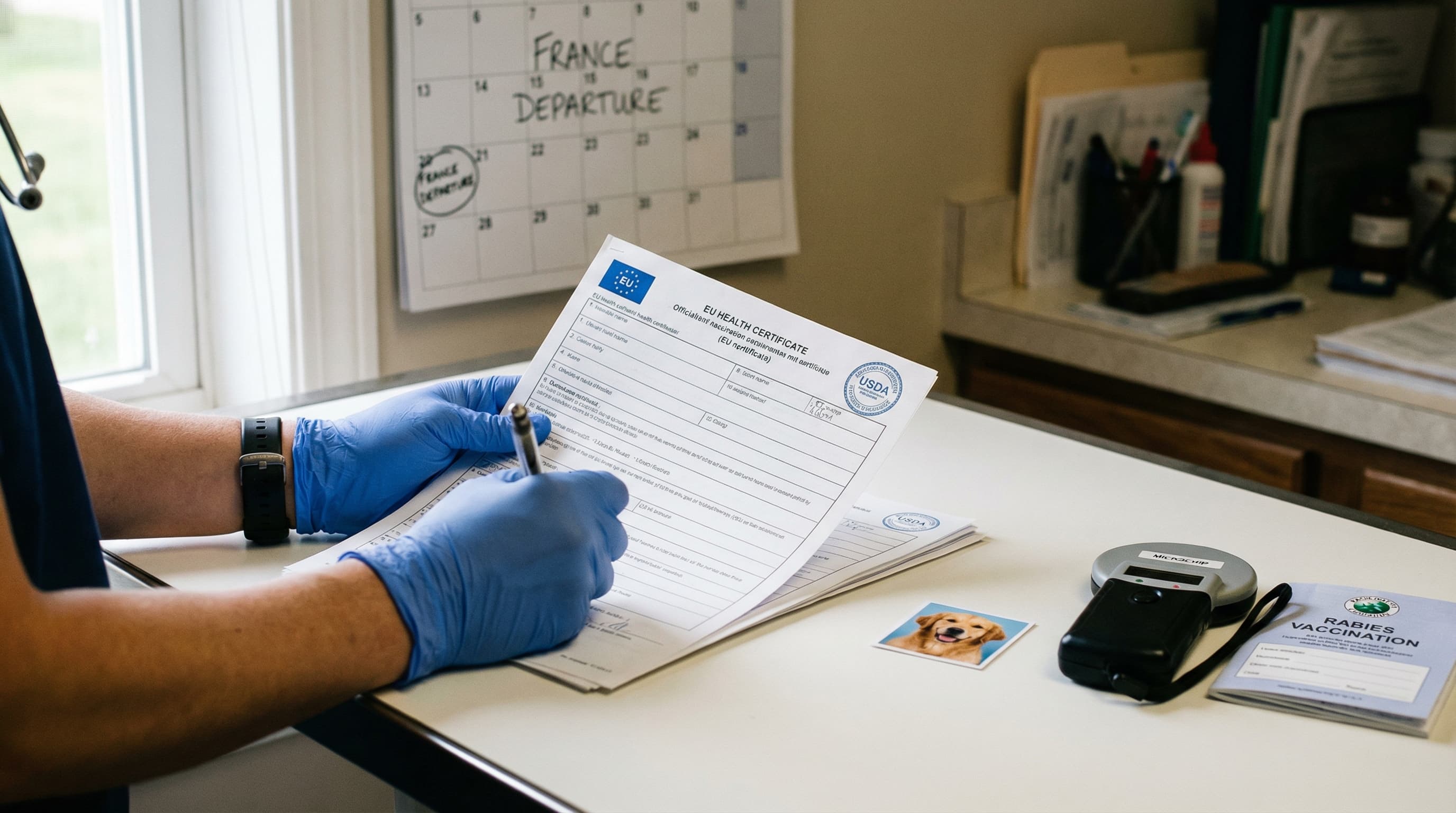
Your pet needs an ISO 11784/11785 microchip (15-digit) implanted before the rabies vaccine. If your pet got the rabies shot before the microchip, France won't accept it. You'd need a new vaccination and a new 21-day wait.
Critical
The 21-day wait applies only to primary vaccinations. If your pet already has a current rabies vaccine that was given after microchipping, and the booster is up to date, there's no waiting period.
Most vets handle EU pet travel paperwork regularly and know this timing.
Microchip cost: $25–50. Rabies vaccine: $15–30. Your vet can do both in the same visit, but the chip goes in first. Airport officials in France scan the microchip to match your pet to its health certificate.
EU Health Certificate
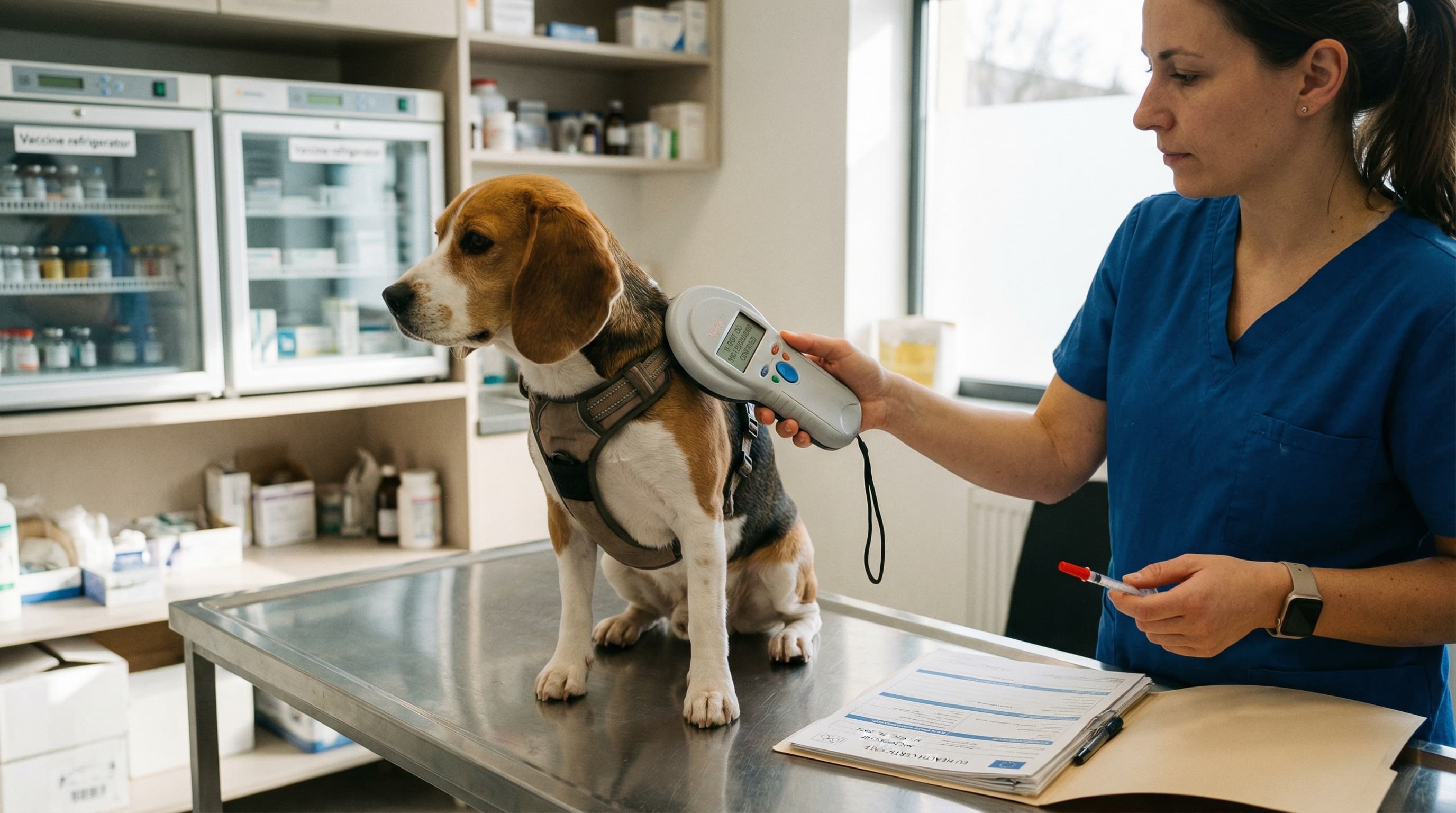
France accepts the EU non-commercial health certificate for pets traveling with their owners. A USDA-accredited vet fills this out after examining your pet and confirming the microchip number, rabies vaccine dates, and overall health. Not every vet holds this accreditation — find one near you.
Your vet signs the certificate, and it's valid for 30 days from that date. USDA endorsement must happen within 10 days of your arrival in France — this is a strict window with no exceptions.
Schedule the vet visit about 7–10 days before your flight, then send the certificate to your regional USDA endorsement office immediately. If endorsement comes back after your 10-day window closes, you start over with a new vet visit and new fee.
Most USDA offices process endorsements in 2–3 business days by mail. In-person endorsement is same-day at most offices. The certificate needs an original ink signature and USDA stamp/emboss. Airlines check this at the counter before they let your pet board.
USDA Endorsement
USDA endorsement is the government stamp confirming your vet filled out the health certificate correctly. This requirement applies specifically to pets traveling from the United States. France won't accept an unendorsed certificate from US-origin pets.
The endorsement costs $101 per certificate when no lab tests are needed (France doesn't require any for travelers from the US, a listed third country). If you're traveling with multiple pets on the same certificate, it's still $101 total. Without this stamp, French customs will reject your health certificate at the border.
Options:
- By mail: 2–3 business days. Ship overnight both ways if your timeline is tight
- In person: Same-day at your regional APHIS office. Call ahead to confirm hours and walk-in availability
The endorsed certificate lasts 10 days for entry into the EU. Once you're in France, it covers travel within the EU for 4 months from the date of issuance, as long as the rabies vaccine stays current.
If you're visiting multiple EU countries, you don't need separate certificates for each one—though Ireland, Finland, Malta, and Norway require extra tapeworm treatment annotation administered 24–120 hours before entry to those countries.
TipIf you're traveling with two dogs or two cats, your vet can list both on one certificate. USDA charges $101 per certificate, not per pet—same endorsement fee whether you have one pet or five on the form.
France's Banned Dog Breeds
France divides certain breeds into two categories with very different rules. This only applies to dogs. Cats have no breed restrictions.
Category 1 — "Attack dogs" (banned entirely): Dogs that physically resemble these breeds but have no pedigree papers:
- Pit bull types (resembling American Staffordshire Terrier)
- Boerbull types (resembling Mastiff)
- Tosa types
Importing a Category 1 dog into France is a criminal offense: 6 months imprisonment and a €15,000 fine. This applies even to transit. If your dog looks like one of these breeds and you don't have pedigree papers, French authorities will classify it as Category 1 at the border.

Category 2 — "Guard and defense dogs" (allowed with paperwork): The same breeds as Category 1, but with a pedigree registered with a kennel club recognized by the Fédération Cynologique Internationale (FCI):
- American Staffordshire Terrier (with AKC or equivalent pedigree)
- Rottweiler (with or without pedigree)
- Tosa (with pedigree)
Category 2 dogs can enter France if you carry proof of pedigree from a recognized kennel club. AKC registration works for American Staffordshire Terriers. Without that paperwork, French authorities classify the dog as Category 1 and refuse entry.
If your dog is Category 1 (or looks like it without pedigree papers), that's a genuinely difficult situation. France bans entry completely—6 months imprisonment and a €15,000 fine. There's no workaround.
If there's any question about your dog's breed, bring AKC or equivalent pedigree documents to prove Category 2 status.
While Category 2 dogs can enter France, they're subject to public safety restrictions: they must be muzzled in public spaces and on a leash held by someone 18+.
If you're staying in France long-term, you'll also need a "Permis de Détention" (ownership permit) from your local Mairie (town hall). For short tourist visits, the pedigree papers and muzzle requirement apply.
Watch OutFrench customs classifies dogs by appearance, not breed name. A mixed-breed dog that looks like a Pit Bull with no papers is Category 1 at the border — the ban applies on transit too. If your dog resembles any restricted breed, bring pedigree documents even if you think it's obvious.
Airline Rules for Flying Pets to France
Country rules and airline rules are separate. Meeting France's import requirements doesn't guarantee your airline will accept your pet. Airlines add their own restrictions on top.
Air France is the most common carrier for US-to-France pet travel:
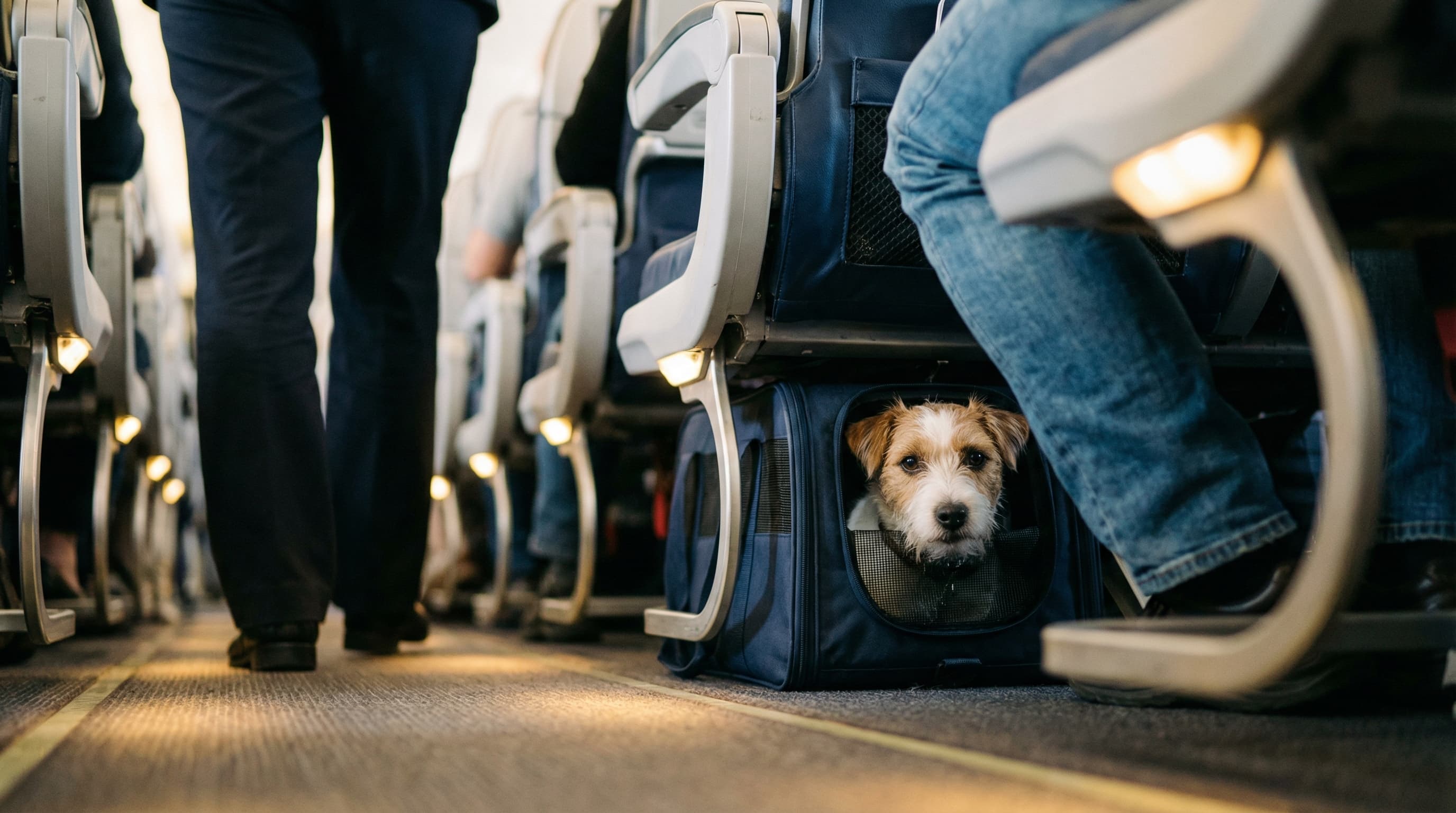
- Cabin: pets up to 8 kg (17.6 lbs) including soft carrier (max 46 x 28 x 24 cm). Fee: €200 transatlantic
- Hold: pets over 8 kg, up to 75 kg including hard-sided IATA crate. Fee: €200–400 depending on route
- Flat-faced breeds (French Bulldogs, Pugs, Boxers) can fly in the cabin but are banned from the hold due to breathing risks
- Book via "My Bookings" at least 48 hours before departure for cabin, 24 hours for hold
- Pets over 75 kg including crate go through Air France-KLM Cargo
Delta: $200 each way for cabin pets on international flights. Does accept cabin pets to France (unlike the UK and Ireland, where Delta blocks cabin pets). Carrier max: 18 x 11 x 11 inches.
United: $200 each way for cabin pets on international flights. Carrier max: 18 x 11 x 11 inches. Confirm France allows cabin pets when booking (it does).
All three airlines require pets to be at least 15 weeks old for EU travel. Call your airline 3–4 weeks before travel to reserve a pet spot.
Most flights limit cabin pets to 2–4 per aircraft, and this isn't advertised anywhere — people find out when they're told the flight is full. For more airline details, see our airline fee comparison.
Cost Breakdown
France entry rules are identical for dogs and cats. The cost difference comes from US re-entry requirements and whether your pet flies cabin or hold.
Cabin Travel (One Way)
| Vet exam + EU health certificate | $50–150 | USDA-accredited vet required |
| Rabies vaccine (if needed) | $15–30 | Skip if current and post-microchip |
| Microchip (if needed) | $25–50 | ISO 15-digit, skip if already chipped |
| USDA endorsement | $101 | Per certificate, not per pet |
| Airline pet fee (cabin) | $200 | Delta, United / €200 Air France |
| SIVEP inspection fee (arrival) | ~$55–65 | €50–€60 at Paris CDG and other inspection posts |
| Total (one way, cabin) | $450–650 |
Hold Travel (One Way)
| Vet exam + EU health certificate | $50–150 | USDA-accredited vet required |
| Rabies vaccine (if needed) | $15–30 | Skip if current and post-microchip |
| Microchip (if needed) | $25–50 | ISO 15-digit, skip if already chipped |
| USDA endorsement | $101 | Per certificate, not per pet |
| IATA-compliant crate | $75–300 | Size-dependent, one-time purchase |
| Airline pet fee (hold) | €200–400 | Air France, route-dependent |
| SIVEP inspection fee (arrival) | ~$55–65 | €50–€60 at Paris CDG and other inspection posts |
| Total (one way, hold) | $550–950 |
Timeline
6–8 weeks before: Confirm your pet's microchip is ISO 15-digit. If no chip, get one implanted now. If your pet needs a rabies vaccine (first-time or lapsed booster), get it at the same visit, after the microchip. The 21-day clock starts at vaccination.
4 weeks before: Call your airline to reserve a pet spot. Book early because cabin spots fill up fast on transatlantic routes. Confirm carrier dimensions meet your airline's requirements.
10 days before (at most): Schedule your USDA-accredited vet appointment. The vet examines your pet, confirms the microchip number, reviews rabies records, and fills out the EU health certificate.
7–8 days before: Send the signed health certificate to your regional USDA endorsement office by overnight mail. Or drive there for same-day endorsement. You need the endorsed certificate back in your hands before you fly.
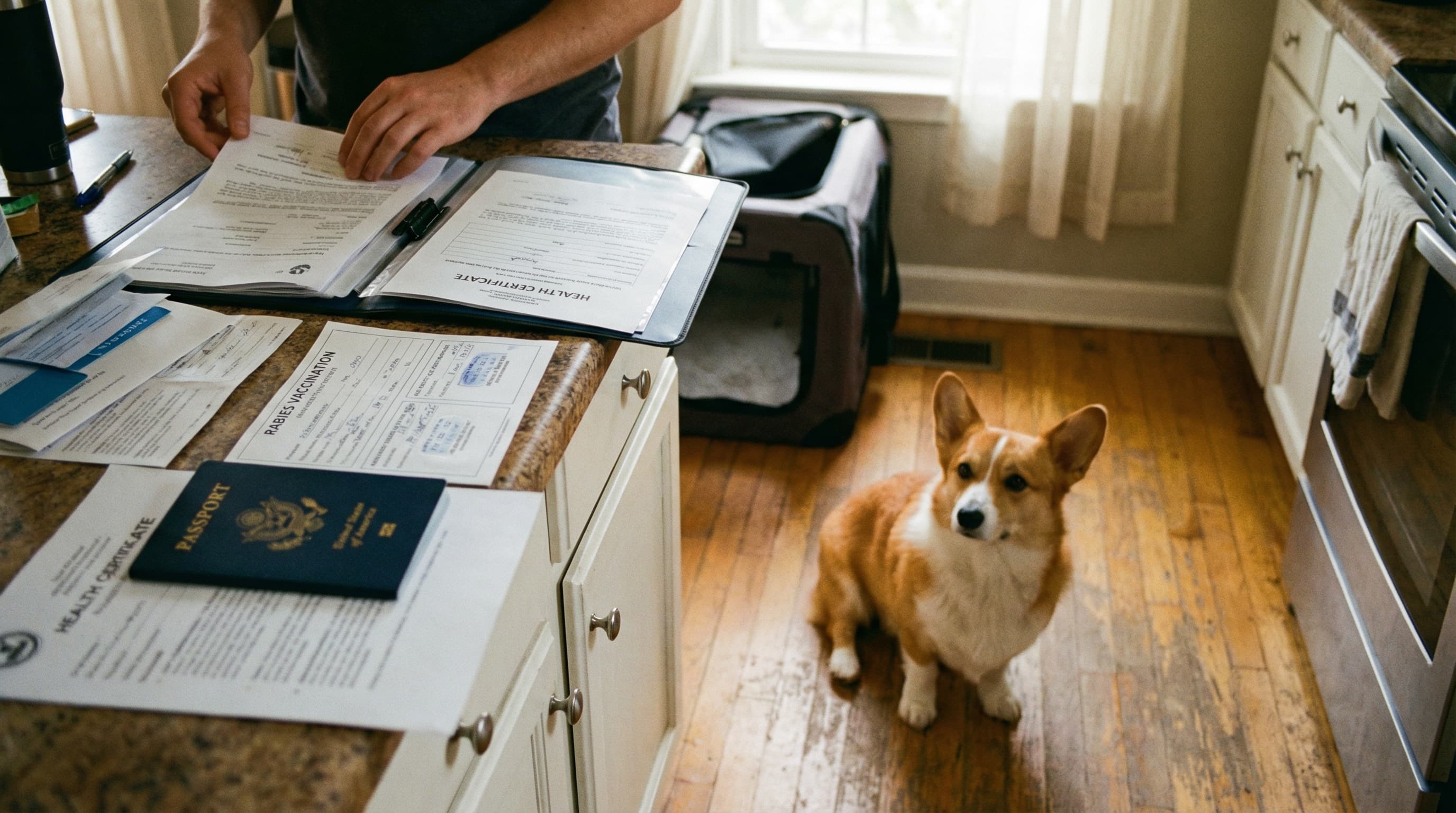
1–2 days before: Confirm your airline reservation for the pet. Print all documents. Pack originals in a waterproof folder in your carry-on.
Travel day: Arrive at the airport 60–90 minutes earlier than usual. The airline checks your pet's health certificate and endorsement at the counter. In France, present your pet and documents to customs at the border inspection post.
Common Mistakes
Getting the health certificate too early
The USDA endorsement must happen within 10 days of arriving in France. If your vet visit is 14 days before your flight, you've blown the window. Count backward from your arrival date, not your departure date.
Thinking a 3-year rabies vaccine means 3 years of EU validity
Under EU rules, the first rabies vaccine after microchip implantation is a "primary" shot valid for only 1 year. Boosters administered before the vaccine expires can be valid for 1–3 years per manufacturer instructions, with no waiting period. This catches people who got their pet vaccinated years ago and are now adding a chip for travel. New chip means new vaccine means new 21-day wait.
Confusing "primary" and "booster" rabies vaccination timing
The 21-day wait only applies to primary vaccinations (first-time shots or lapsed boosters). If your pet has a current, valid rabies vaccine that was administered after microchipping and before expiration, there's no waiting period.
Not checking pedigree requirements for restricted breeds
If your dog is an American Staffordshire Terrier, Rottweiler, or Tosa, you need proof of pedigree. Without it, French authorities classify the dog as Category 1 (banned). AKC registration papers work. Bring the originals.
Booking a flight that doesn't stop at a border inspection post
Pets from non-EU countries must enter France through Paris CDG, Paris Orly, Marseille, Nice, Lyon, or Toulouse. If your flight lands at a different French airport, your pet can't clear customs there. Check your routing.
Forgetting about the return trip
Dogs returning to the US need a CDC Dog Import Form (free, filled out online before travel) and a microchip. Cats have no federal re-entry paperwork. Read the Returning to the US section before booking.
Planning onward travel to Ireland, Finland, Malta, or Norway without tapeworm treatment
France itself doesn't require tapeworm treatment, but if you're continuing to these four EU countries, your pet needs praziquantel administered by a vet 24–120 hours before entry to those destinations, with the treatment recorded on your health certificate.
Airport Tips
Departing the US: Check in at the airline counter, not a kiosk. The agent needs to review your endorsed health certificate and rabies records before issuing a boarding pass. For cabin pets, your carrier counts as your personal item on most airlines. For hold pets, drop off the crate at the oversized baggage area after document review.
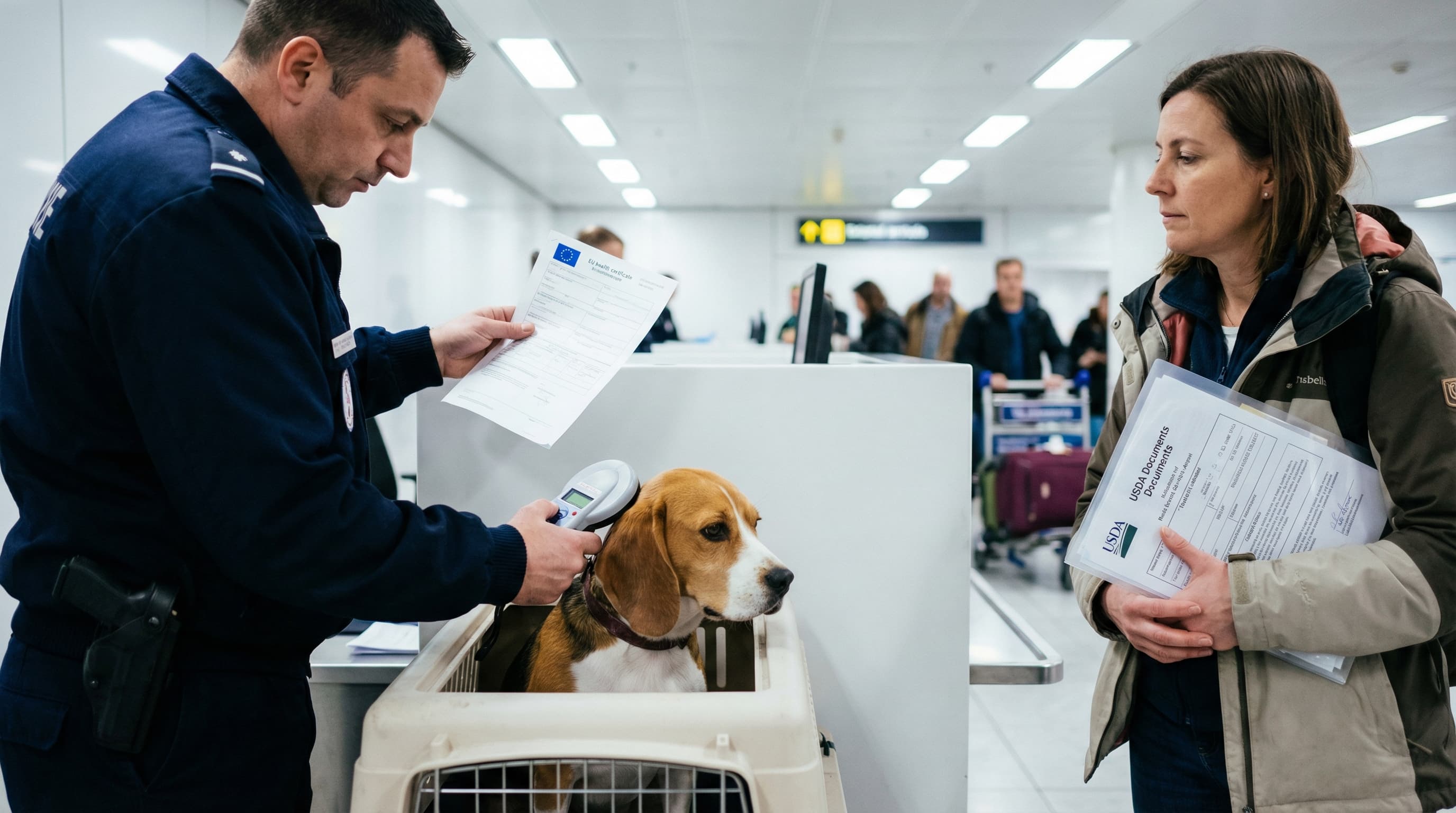
Arriving in France: Follow signs to customs. Not all arrivals go through the same lane; look for the pet/animal declaration area at the border inspection post. A customs officer checks your health certificate, confirms the microchip number with a scanner, and reviews vaccine records. If everything matches, you're through in 10–15 minutes. Keep documents accessible, not buried in checked luggage.
Paris CDG specifics: Most US flights land at Terminal 2E. The customs/veterinary inspection area handles pet arrivals daily. This is routine for CDG staff.
If you're connecting to another EU country, France is your point of entry for customs clearance. After that, your pet can travel freely within the EU on the same health certificate for 4 months.
Returning to the US
Dogs
France is a CDC low-risk country for dog rabies. Returning is straightforward:
- Complete the CDC Dog Import Form online before your return flight. It's free. Save the receipt
- Dog must have a microchip readable by a universal scanner (you already have one from France's entry requirements)
- Dog must be at least 6 months old
- Dog must appear healthy on arrival
- Show the CDC form receipt to your airline before boarding and to US Customs on arrival
No screwworm certificate needed (France is not screwworm-affected). No separate US health certificate needed for re-entry from low-risk countries.
Cats
Federal re-entry rules for cats are minimal:
- Cat must appear healthy on arrival. That's the main CDC requirement
- No CDC import form (the Dog Import Form is dog-specific)
- No federal microchip requirement for US re-entry
- No screwworm certificate
Your cat already has a microchip and rabies vaccine from the France entry process. Keep those records for your own files, but US customs doesn't require them federally. Check your home state's rules; many states require rabies vaccination for cats, and Hawaii quarantines all arriving cats.
For detailed instructions on paperwork, CDC forms, and what to expect at US customs, see our complete guide to re-entering the US with a pet.

FAQ
Your next step: Book a USDA-accredited vet appointment 7–10 days before your flight. That's the bottleneck that controls your entire timeline.