The first rabies vaccine given after microchip implantation counts as a "primary" vaccination under EU rules. It's valid for only 1 year, even if the label says 3 years. Boosters given within 12 months of the primary can be valid for 1–3 years per the manufacturer's instructions. If the booster lapses by even one day, the next shot resets to "primary" status.

Bringing a Dog or Cat to Germany from the US — 2026 Requirements
16 min readinternational

Lisa Carter
International Pet Relocator
| Applies to | Dogs and cats (same entry rules except breed restrictions are dogs only) |
| Documents | EU health certificate + USDA endorsement + rabies certificate |
| Vaccines | Rabies (12+ weeks old, 21-day wait after first shot) |
| Microchip | Required (ISO 15-digit, before rabies vaccine) |
| Quarantine | None |
| Cost (One way) | $375–$550 (cabin) / $500–$950 (hold) |
| Timeline | Start 4–6 weeks before |
| Difficulty | 🟡 Moderate |
Flying to Germany from the US with your dog or cat costs $375–550 one way for cabin travel and takes 4–6 weeks of prep. Germany follows standard EU import rules: ISO microchip, rabies vaccine with a 21-day wait, an EU health certificate from a USDA-accredited vet, and USDA endorsement ($101).
No quarantine, no blood test, no import permit.
Two things set Germany apart. First, Lufthansa's cabin pet fee is $120–160 for transatlantic flights, cheaper than most US carriers.
Second, Germany has a federal ban on four dog breeds plus state-level restrictions that vary by Bundesland, so where you're going in Germany matters as much as what breed you have. This guide covers both directions for dogs and cats.
What You Need
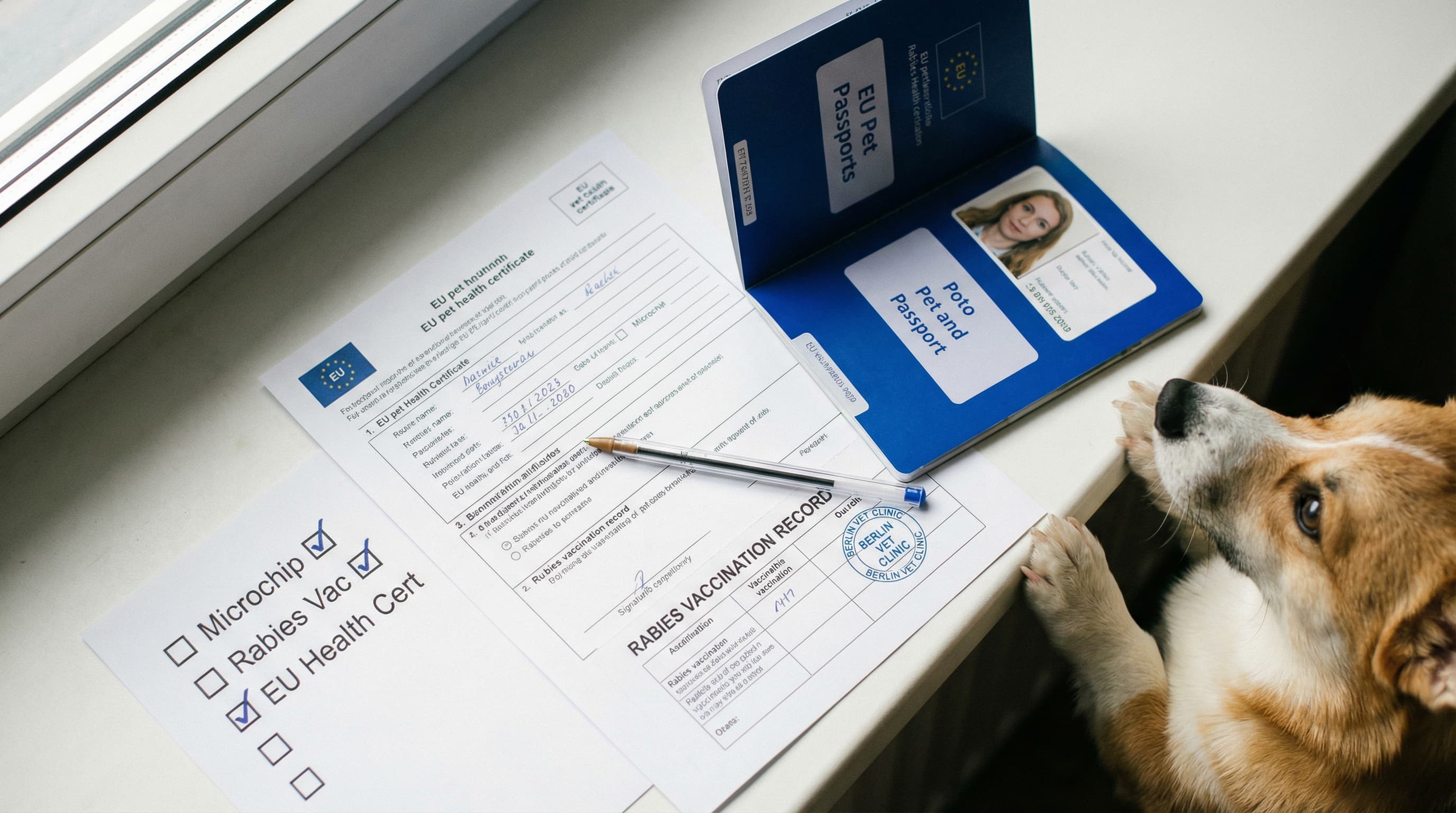
Germany is an EU member state. Pets from the US enter under EU Regulation 576/2013 for non-commercial movement. The rules are the same for dogs and cats (breed restrictions aside).
- ISO 15-digit microchip: implanted before the rabies vaccine
- Rabies vaccine: given after the microchip; pet must be at least 12 weeks old; first-time shots need a 21-day wait before travel
- EU health certificate + USDA endorsement: signed by a USDA-accredited vet; endorsement must happen within 10 days of arriving in Germany ($101)
- Owner or authorized person must travel with the pet (or arrive within 5 days); max 5 pets per person
- Entry through an approved border inspection post: Frankfurt, Munich, Berlin, Hamburg, Hannover (HAJ), Köln, Hahn, or Leipzig-Halle (LEJ)
What you don't need: No quarantine, no import permit, no titer test (the US is on the EU's approved country list).
Rabies Vaccine and Microchip
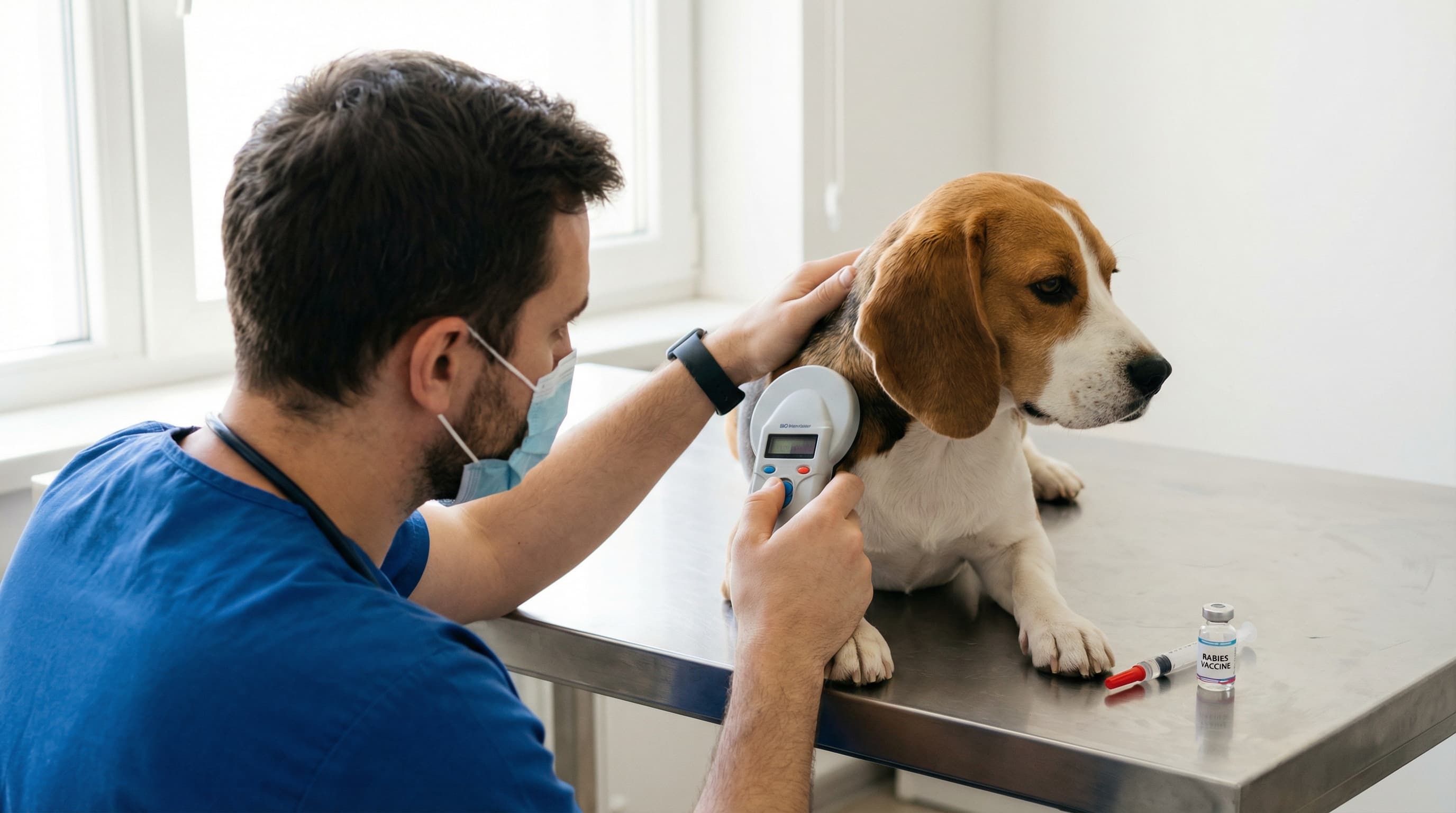
Your pet needs an ISO 11784/11785 microchip (15-digit) implanted before the rabies vaccine. If your pet got the rabies shot before the microchip, Germany won't accept it. You'd need a new vaccination and a new 21-day wait.
Critical
The 21-day wait applies only to primary vaccinations. If your pet already has an active rabies vaccine that was given after microchipping, and the booster is up to date, there's no waiting period. Most USDA-accredited vets have filled out EU health certificates before.
Microchip cost: $25–50. Rabies vaccine: $15–30. Your vet can do both in the same visit, but the chip goes in first. Customs officials in Germany scan the microchip to match your pet to its health certificate.
EU Health Certificate
Germany accepts the EU non-commercial health certificate for pets traveling with their owners. A USDA-accredited vet fills this out after examining your pet and confirming the microchip number, rabies vaccine dates, and overall health. Not every vet holds this accreditation — find one near you.
The certificate is valid for 30 days from the date your vet signs it. USDA endorsement must happen within 10 days of your arrival in Germany. Schedule the vet visit about 7–10 days before your flight, then send the certificate to your regional USDA endorsement office immediately.
Most USDA offices process endorsements in 2–3 business days by mail. In-person endorsement is same-day at most offices. The certificate needs an original ink signature and USDA stamp/emboss. Airlines check this at the counter before your pet boards.
Once you're in Germany, the same certificate covers travel within the EU for 4 months. Visiting France or the Netherlands after Germany doesn't need separate paperwork.
USDA Endorsement
USDA endorsement is the government stamp confirming your vet filled out the health certificate correctly. Germany won't accept an unendorsed certificate.
The endorsement costs $101 per certificate when no lab tests are needed (Germany doesn't require any for US travelers). If you're traveling with multiple pets on the same certificate, it's still $101 total. Without this stamp, German customs will reject your health certificate at the border.
Options:
- By mail: 2–3 business days. Ship overnight both ways if your timeline is tight
- In person: Same-day at your regional APHIS office. Call ahead to confirm hours and walk-in availability

Germany's Banned and Restricted Dog Breeds
Germany has the most layered breed restriction system in the EU. There's a federal ban, and then each of the 16 Bundesländer (states) adds its own rules on top. This only applies to dogs. Cats have no breed restrictions.
If your dog is on the federal ban list, that's a hard situation. The exceptions below are narrow but real.
Federal Ban (All of Germany)
The Hundeverbringungs- und -einfuhrbeschränkungsgesetz (Dog Transfer and Import Restrictions Act) bans importing these breeds and their crossbreeds:
- Pit Bull Terrier
- American Staffordshire Terrier
- Staffordshire Bull Terrier
- Bull Terrier
This is a federal law, not a state-level rule. It applies everywhere in Germany, with limited exceptions.
Exceptions: Dogs from the banned list can enter Germany if the owner is visiting for fewer than 4 weeks, or if the dog is a service/guide dog, rescue dog, or a military/government working dog. Returning German residents who had prior authorization to keep the dog can also bring it back. All exceptions require paperwork.
State-Level Restrictions (Varies by Bundesland)
On top of the federal ban, individual states restrict other breeds. The most commonly restricted breeds at the state level include Rottweiler, Dogo Argentino, Mastiff, Tosa Inu, Cane Corso, and Fila Brasileiro.
| State | Other restricted breeds (beyond federal list) |
|---|---|
| Bavaria | Tosa Inu, Bandog, plus presumed dangerous: Rottweiler, Dogo Argentino, Cane Corso, Mastiff, and others |
| Baden-Württemberg | Bullmastiff, Dogo Argentino, Fila Brasileiro, Mastiff, Tosa Inu |
| Hamburg | Rottweiler, Dogo Argentino, Mastiff, Kangal, Caucasian Shepherd, Tosa Inu |
| Hesse | Rottweiler, American Bulldog, Dogo Argentino, Kangal, Caucasian Shepherd |
| Brandenburg | Other restrictions (check locally) |
Watch OutA Rottweiler can enter Germany legally under federal law, but specific states like Bavaria, Hamburg, and Hesse classify Rottweilers as dangerous. If you're flying into Frankfurt (Hesse) with a Rottweiler, you need to check Hesse's rules, not just the federal ones. Contact the local Ordnungsamt (public order office) in your destination city before booking.
If your dog is on a state's restricted list, you may still be able to bring it with an official authorization from local authorities and a behavioral assessment (Wesenstest). This process takes time and paperwork, so start early.

Airline Rules for Flying Pets to Germany
Country rules and airline rules are separate. Meeting Germany's import rules doesn't guarantee your airline will accept your pet. Airlines add their own restrictions on top.
Lufthansa is the most common carrier for US-to-Germany pet travel:
- Cabin: pets up to 8 kg (17.6 lbs) including soft carrier (max 55 x 40 x 23 cm). Fee: $120–160 transatlantic
- Hold (excess baggage): varies by crate size, $150–437 for intercontinental routes. IATA-compliant hard-sided crate required
- Flat-faced breeds (Pugs, Bulldogs, Boxers, Shih Tzus) can fly cabin but are banned from hold due to breathing risks
- Register at least 72 hours before departure through the Lufthansa Service Center or "My Bookings" online
- Hold pets not accepted on connecting flights via Munich; Frankfurt connections work
Delta: $200 each way for cabin pets on international flights. Accepts cabin pets to Germany. Carrier max: 18 x 11 x 11 inches.
United: $200 each way for cabin pets on international flights. Carrier max: 18 x 11 x 11 inches.
All airlines require pets to be at least 15 weeks old for EU travel. Call your airline 3–4 weeks before travel to reserve a pet spot. Most flights limit cabin pets to 2–4 per aircraft. For more airline details, see our airline fee comparison.
Cost Breakdown
Germany entry rules are identical for dogs and cats. The cost difference comes from your airline choice and whether your pet flies cabin or hold.
Cabin Travel (One Way)
| Vet exam + EU health certificate | $50–150 | USDA-accredited vet required |
| Rabies vaccine (if needed) | $15–30 | Skip if active and post-microchip |
| Microchip (if needed) | $25–50 | ISO 15-digit, skip if already chipped |
| USDA endorsement | $101 | Per certificate, not per pet |
| Airline pet fee (cabin) | $120–200 | Lufthansa $120–160 / Delta, United $200 |
| Total (one way, cabin) | $375–550 |
Hold Travel (One Way)
| Vet exam + EU health certificate | $50–150 | USDA-accredited vet required |
| Rabies vaccine (if needed) | $15–30 | Skip if active and post-microchip |
| Microchip (if needed) | $25–50 | ISO 15-digit, skip if already chipped |
| USDA endorsement | $101 | Per certificate, not per pet |
| IATA-compliant crate | $75–300 | Size-dependent, one-time cost |
| Airline pet fee (hold) | $150–437 | Lufthansa, crate-size dependent |
| Total (one way, hold) | $500–950 |
Cost SaverLufthansa's transatlantic cabin fee is $120–160, compared to $200 on Delta and United. If your pet fits in cabin (under 8 kg with carrier), Lufthansa saves you $40–80 each way.

Timeline
6–8 weeks before: Confirm your pet's microchip is ISO 15-digit. If no chip, get one implanted now. If your pet needs a rabies vaccine (first-time or lapsed booster), get it at the same visit, after the microchip. The 21-day clock starts at vaccination. If your dog is on a state restricted breed list, contact the local Ordnungsamt now to ask about authorization and behavioral assessments.
4 weeks before: Call your airline to reserve a pet spot. Lufthansa requires 72 hours notice but book much earlier for transatlantic routes. Confirm carrier dimensions meet your airline's requirements.
10 days before (at most): Schedule your USDA-accredited vet appointment. The vet examines your pet, confirms the microchip number, reviews rabies records, and fills out the EU health certificate.
7–8 days before: Send the signed health certificate to your regional USDA endorsement office by overnight mail. Or drive there for same-day endorsement. You need the endorsed certificate back in your hands before you fly.
1–2 days before: Confirm your airline reservation for the pet. Print all documents. Pack originals in a waterproof folder in your carry-on.

Travel day: Arrive at the airport 60–90 minutes earlier than usual. The airline checks your pet's health certificate and endorsement at the counter. In Germany, present your pet and documents to customs at the border inspection post.
Common Mistakes
Airport Tips
Departing the US: Check in at the airline counter, not a kiosk. The agent reviews your endorsed health certificate and rabies records before issuing a boarding pass. For cabin pets, your carrier counts as your personal item on most airlines. For hold pets, drop off the crate at the oversized baggage area after document review.
Arriving in Germany: Follow signs to customs and the veterinary border inspection post. A customs officer checks your health certificate, scans the microchip, and reviews vaccine records. Frankfurt handles the most US arrivals and processes pet inspections daily. If everything matches, you're through in 10–15 minutes.
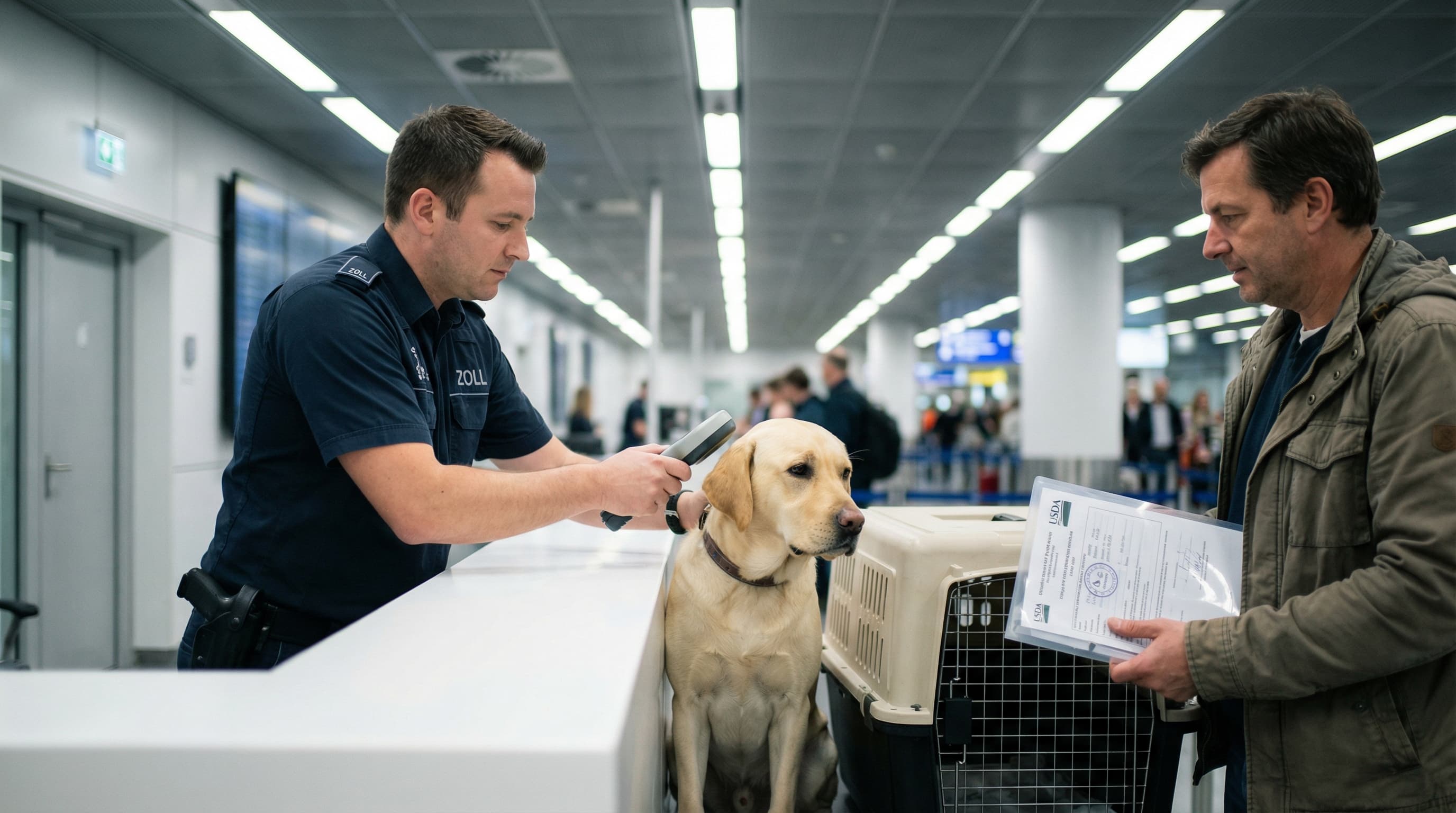
Germany after arrival: Germany is one of the most dog-friendly countries in Europe. Dogs are welcome in most restaurants, many shops, and on all public transit (with a ticket in some cities). Trains, buses, and U-Bahns allow dogs; large dogs typically need a muzzle on public transit in some cities. If you're connecting to another EU country, Germany is your point of entry for customs clearance, and the same health certificate covers EU travel for 4 months.

Returning to the US
Dogs
Germany is a CDC low-risk country for dog rabies. Returning is straightforward:
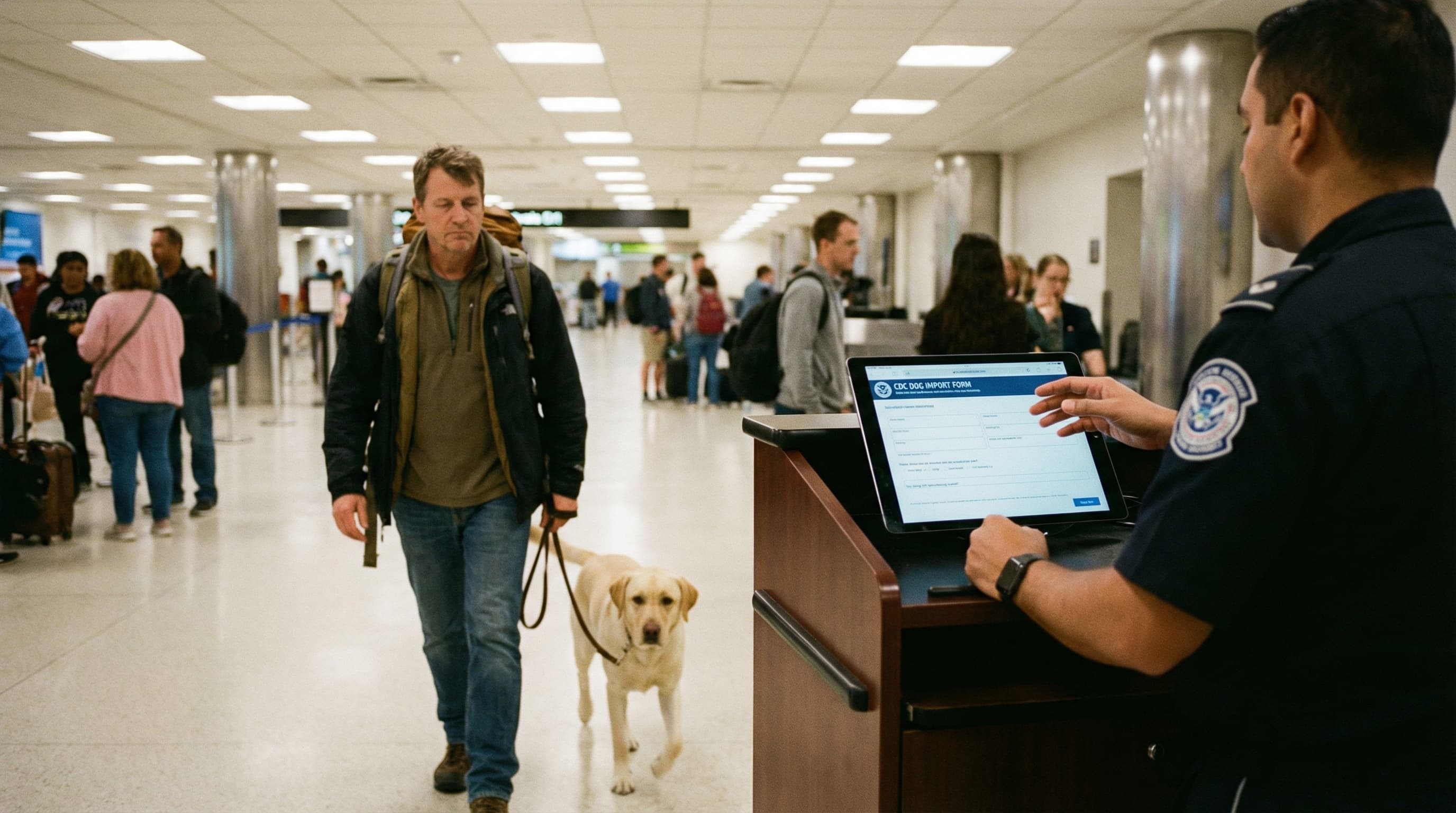
- Complete the CDC Dog Import Form online before your return flight. It's free. Save the receipt
- Dog must have a microchip readable by a universal scanner (you already have one from Germany's entry requirements)
- Dog must be at least 6 months old
- Dog must appear healthy on arrival
- Show the CDC form receipt to your airline before boarding and to US Customs on arrival
No screwworm certificate needed. No separate US health certificate for re-entry from low-risk countries.
Cats
Federal re-entry rules for cats are minimal:
- Cat must appear healthy on arrival. That's the main CDC requirement
- No CDC import form (the Dog Import Form is dog-specific)
- No federal microchip requirement for US re-entry
- No screwworm certificate
Your cat already has a microchip and rabies vaccine from Germany's entry process. Keep those records handy, but US customs doesn't require them federally. Check your home state's rules; many states require rabies vaccination for cats, and Hawaii quarantines all arriving cats.
For more details on both species, see our guide to re-entering the US with a pet.
FAQ
Your next step: Check your destination state's breed restrictions (if you have a dog), then book a USDA-accredited vet appointment 7–10 days before your flight. Those are the two bottlenecks.