Your vet must implant the microchip before giving the rabies vaccine. If the chip goes in after the shot, the EU considers that vaccine invalid. Your pet can't enter Greece, and you'd need a new vaccine plus a fresh 21-day wait. This is the single most common paperwork failure for EU pet travel.

Bringing a Dog or Cat to Greece from the US — 2026 Requirements
19 min readinternational

James Harlow
Pet Relocation Consultant
| Applies to | Dogs and cats (same rules for both) |
| Documents | EU health certificate + USDA endorsement |
| Vaccines | Rabies only (21-day wait after primary shot) |
| Microchip | ISO 15-digit, implanted before rabies vaccine |
| Quarantine | None |
| Breed bans | None |
| Cost | $450–$1,000 (dogs) / $400–$900 (cats) |
| Timeline | Start 3–4 weeks before travel |
| Difficulty | 🟡 Moderate |
Flying to Greece with a pet from the US costs $400–$1,000 round trip and takes 3–4 weeks of prep.
Greece follows standard EU pet import rules: your pet needs an ISO microchip, an active rabies vaccine with a 21-day waiting period, an EU health certificate from a USDA-accredited vet, and a USDA endorsement ($101).
No titer test, no quarantine, no breed bans, no tapeworm treatment.
Dogs and cats have identical entry rules.
What sets Greece apart from other EU destinations: 12+ island Border Inspection Posts, so you can fly your pet directly to Crete, Rhodes, Corfu, or Kos without connecting through Athens.
Once you're in, ferries and domestic flights make island hopping with a pet easy.
Coming home is simpler than getting there. Dogs need a CDC Dog Import Form and a microchip, and cats have almost no federal re-entry rules.

What You Need
Greece uses the same rules for dogs and cats. Every pet flying from the US to Greece needs:
- ISO microchip implanted before the rabies vaccine.
- Active rabies vaccine given at least 21 days before arrival (for a first-time shot). Boosters given before the previous vaccine expired have no waiting period.
- EU health certificate signed by a USDA-accredited vet.
- USDA endorsement within 10 days of arriving in Greece ($101).
- Owner must travel within 5 days before or after the pet arrives (max 5 pets per person), or it's treated as a commercial shipment.
- Pet must be at least 15 weeks old (12 weeks for the rabies vaccine + 21-day waiting period). Greece does not allow a derogation for younger animals.
What you don't need
- Rabies titer test — US is a listed country under EU rules
- Tapeworm treatment — required in Ireland, Finland, Malta, and Norway, but not Greece
- Quarantine
Critical
No Breed Bans
Greece has no breed-specific legislation. No banned breeds for dogs or cats. Pit Bulls, Rottweilers, Dobermans, American Staffordshire Terriers can all enter.
Multiple third-party pet travel websites get this wrong. They list breed bans for Greece that don't exist in Greek law. The actual law (Law 4830/2021) uses a behavior-based approach. It defines a "dangerous pet" as one that "repeatedly exhibits unprovoked and unwarranted aggression."
The official Greek Ministry of Rural Development circular confirms this in writing: "There is no ban for specific breeds (dogs-cats)."
If you own a breed that's restricted in other EU countries (Portugal restricts seven breeds, Ireland restricts eleven), Greece is notably simpler. General leash rules apply to all dogs: leashed and under supervision in public.

Vaccine Rules
Rabies is the only vaccine Greece needs. No distemper, no FVRCP, no tapeworm, no other shots.
Your pet needs an active rabies vaccine given at least 21 days before arriving in Greece. The 21-day count starts the day after the shot, not the day of.
Here's where the EU rules catch people. The EU treats the first rabies vaccine given after a microchip as a "primary" vaccination, and primary shots are only valid for 1 year — even if your vet gave a 3-year vaccine.
Example: Your dog got a 3-year rabies vaccine in 2023. You get an ISO microchip implanted in 2026 for this trip. Even though the 2023 vaccine is still "current" on your vet's records, the EU sees the next rabies shot after the chip as a brand-new primary, valid for 1 year only.
If you don't understand this distinction, you'll show up at the vet expecting to fly next month and find out you need a new vaccine plus 21 days of waiting.
Boosters work differently. If your pet had a primary rabies vaccine within the validity window and gets a booster before it expires, you can travel right away. No 21-day wait. The key is no lapse in coverage. Even one day past expiration resets the clock, and the next shot counts as a new primary.
No titer test is needed. The US is a "listed" country under EU rules (Part 2 of Annex II), so pets traveling from the US skip the rabies blood test that unlisted countries need. That saves $200–$300 and months of waiting compared to destinations like Japan or Australia.
Health Certificate and USDA Endorsement
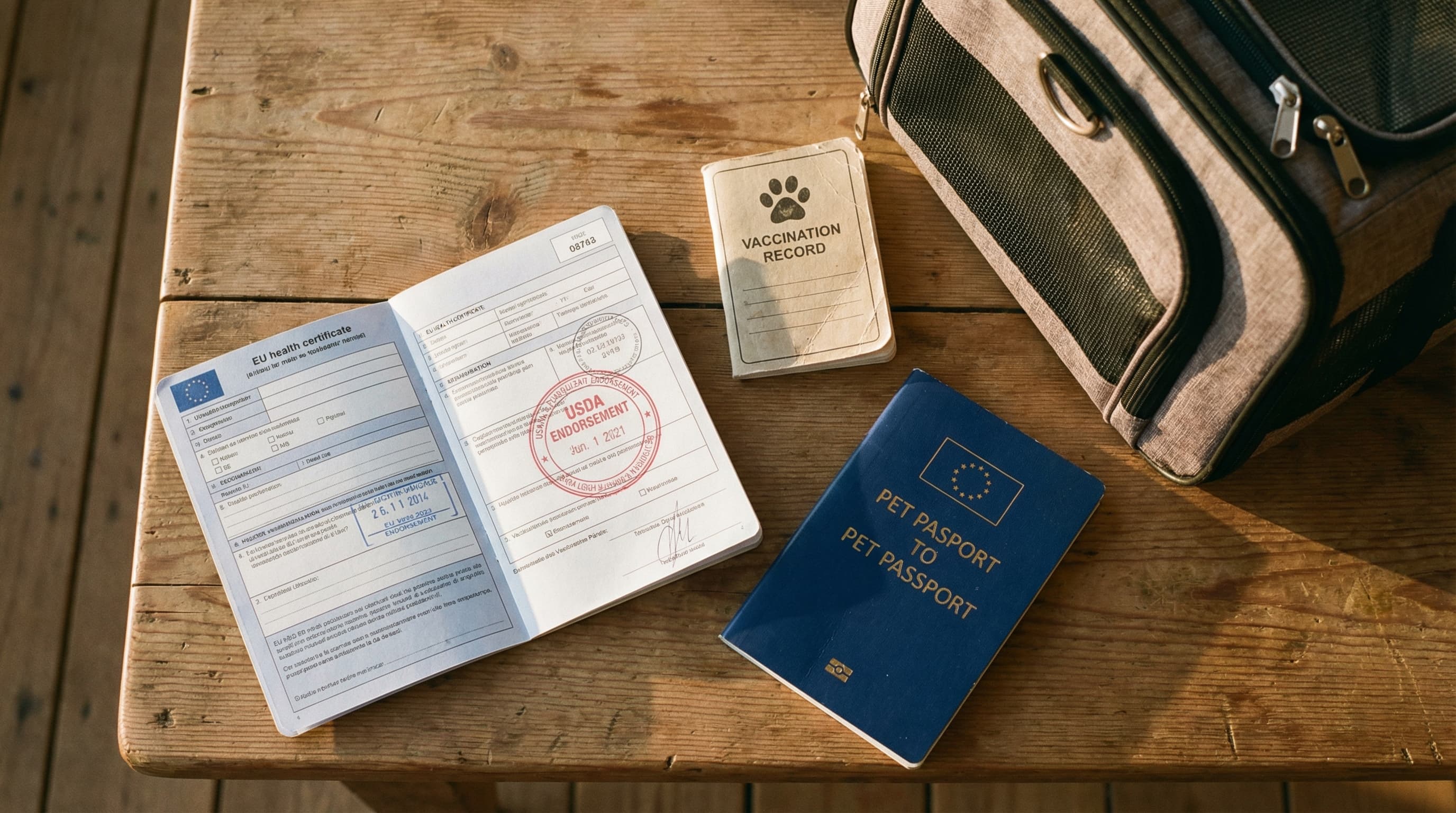
You need an EU non-commercial health certificate for Greece. This is a different form from the standard APHIS 7001 used for most countries. Your vet fills it out through VEHCS (Veterinary Export Health Certification System, USDA's online portal for international pet health forms), and the system has the correct Greece/EU form loaded.
Here's the process:
- Your USDA-accredited vet examines your pet and fills out the EU health certificate in VEHCS. Not every vet holds this accreditation — find one near you.
- You sign a declaration form confirming this is non-commercial travel (not selling the pet).
- The vet submits it to USDA APHIS for endorsement.
- USDA approves the original and mails it back.
- You must bring the physical endorsed certificate with your pet. A digital copy won't work at the Greek border.
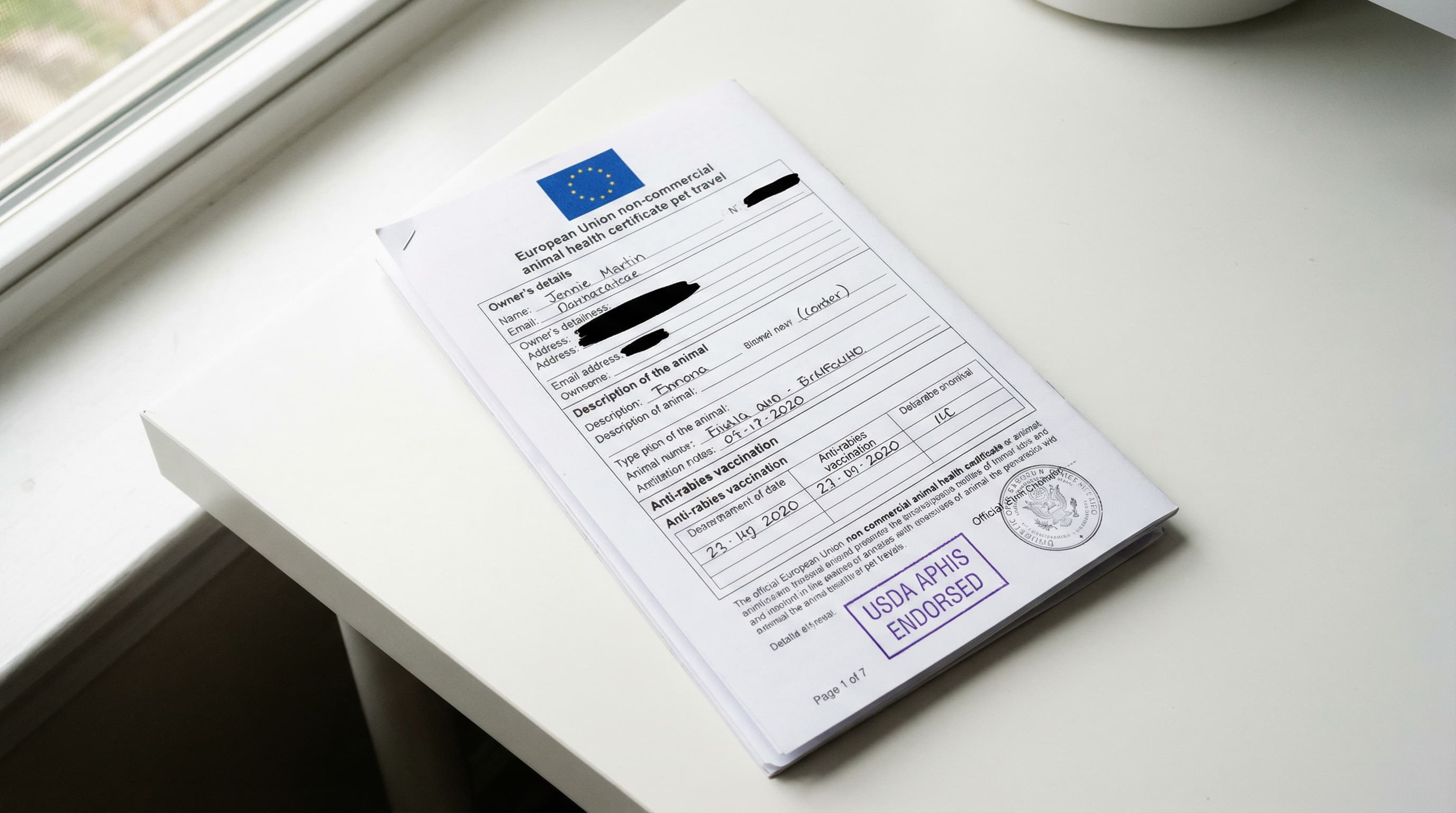
Most USDA-accredited vets have filled out EU health certificates before. This is one of the more common international forms they handle.
The endorsement costs $101 per certificate (updated January 2026). No lab tests are needed for Greece from the US, so $101 is the flat rate. One certificate can cover multiple pets.
Watch OutThe timing on this is tight. USDA must endorse the certificate within 10 days of your arrival in Greece, and you need the physical ink-signed original mailed back to you. VEHCS processes certificates the same day if everything is correct, but budget 3–5 business days for the full round trip through mail. Schedule your vet visit around 7–10 days before your flight.
After entering Greece, the health certificate stays valid for 4 months for travel within the EU. Planning to island hop or head to Italy afterward? You're covered without new paperwork.
For details on health certificates, see our health certificate guide. For the endorsement process, see our USDA endorsement guide.
Microchip
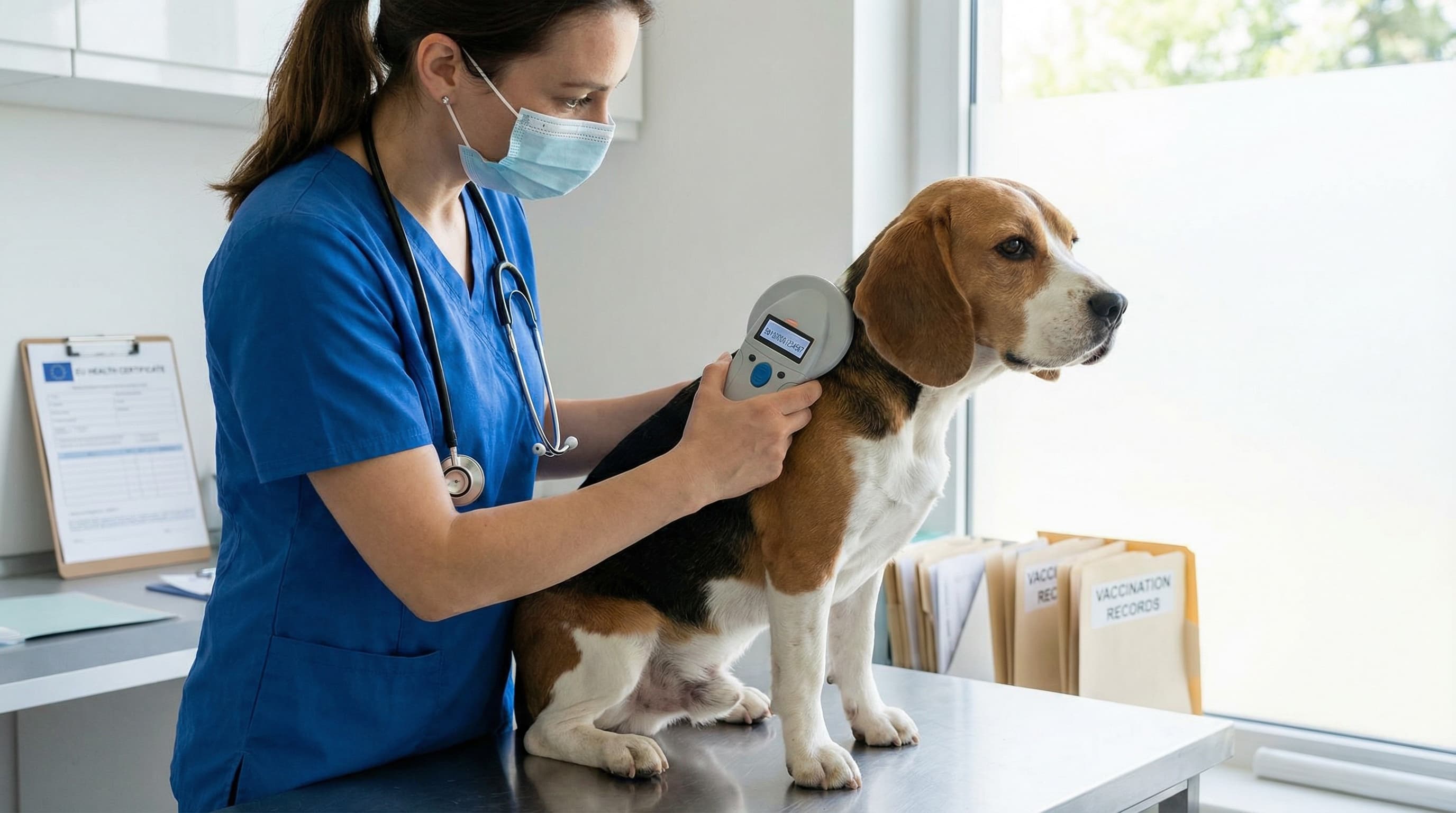
Your pet needs an ISO 11784/11785 15-digit microchip. This is the international standard that Greek border scanners read. Your vet implants it under the skin between the shoulder blades. It takes about 30 seconds and costs $25–$75.
The microchip must go in before the rabies vaccine. Your vet scans the chip to confirm it's working, records the 15-digit number, then gives the rabies shot. This order matters because the EU links the vaccine to the chip number on the health certificate.
Border officials at the BIP scan the microchip and match it against your paperwork. If the numbers don't match, your documents are meaningless.
If your pet already has a non-ISO chip (some older US chips are 9 or 10 digits), you have two options: bring your own compatible scanner, or have your vet implant a second ISO chip. Both chip numbers go on the health certificate.
Airline Rules for Flying to Greece
Airline rules apply on top of Greece's country rules. Most flights from the US land in Athens (ATH), with some seasonal service to Thessaloniki and direct island flights from Europe.
| Routes | Cabin? | Per leg | |
|---|---|---|---|
| United | EWR → ATH (nonstop) | Yes | $150 |
| Delta | JFK, ATL → ATH (nonstop) | Yes | $200 |
| American Airlines | PHL, DFW → ATH via LHR/CDG | No cabin on transatlantic | Cargo only ($450+) |
| Emirates | Various US → ATH via Dubai | Check directly | Varies |
| Turkish Airlines | Various US → ATH via Istanbul | Check directly | Varies |
Delta allows cabin pets ($200) on transatlantic flights to Greece in Main Cabin and Comfort+ classes. This is a relatively recent policy expansion. While some older sources claim Delta bans transatlantic cabin pets, they are permitted if they fit under the seat. Assistance dogs continue to fly free in any cabin.
If you're connecting through London (LHR) or Paris (CDG), you don't need UK or French import paperwork as long as you stay airside during the layover.
Cabin travel: Your pet must fit in a soft carrier under the seat. Weight limits are typically 8 kg (17.6 lbs) total including the carrier. Call the airline 3–4 weeks before travel to reserve a pet spot. Most flights only allow 2–4 pets in cabin.
TipUnited's nonstop EWR–ATH or Delta's nonstop JFK/ATL–ATH flights are the simplest options for pet travel to Greece. Direct flights avoid connection stress and have clear cabin pet policies. If your pet is under 8 kg with carrier, start here.
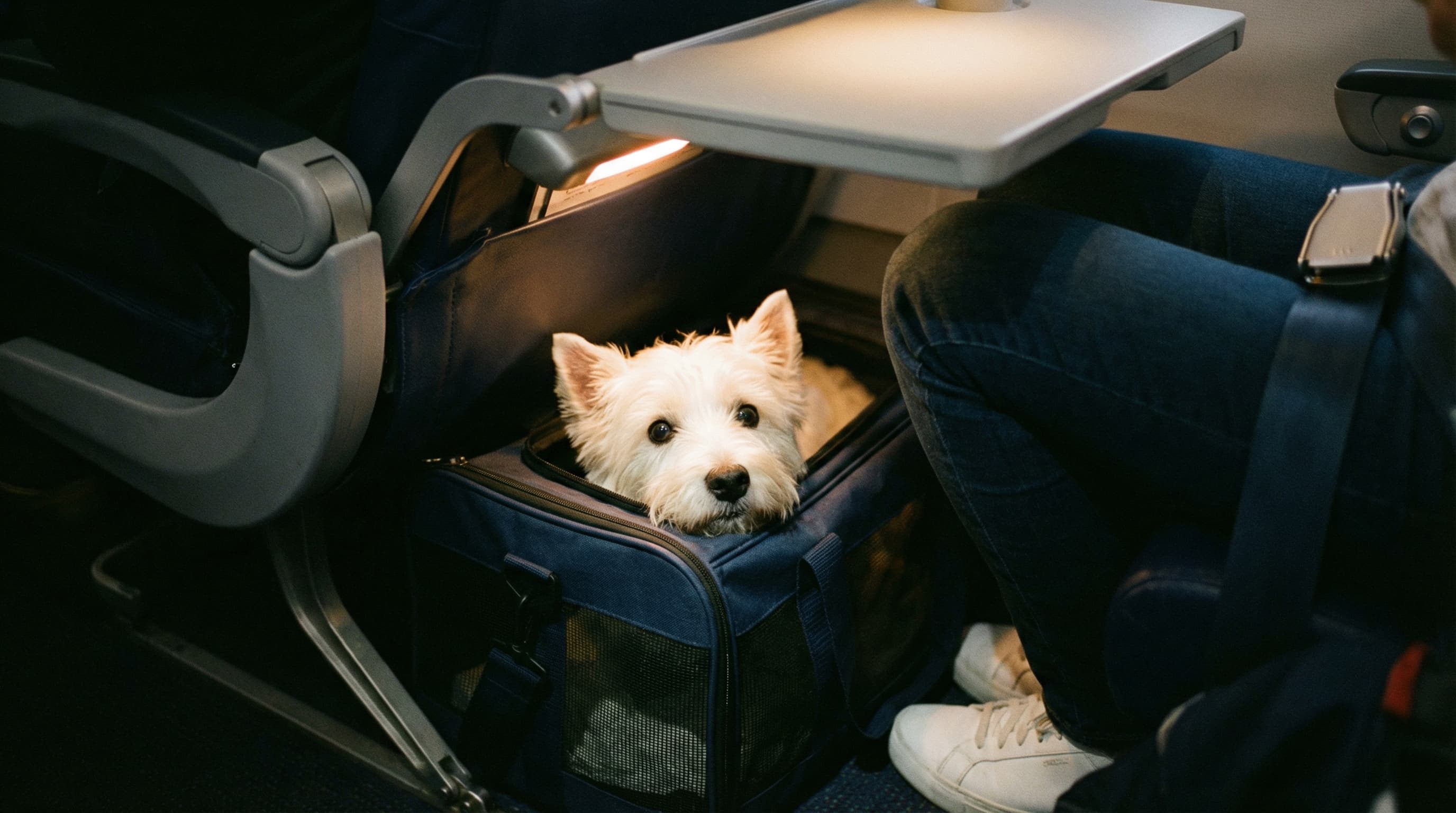
Hold/cargo travel: If your pet is too large for cabin, check with your airline about hold options. It might sound scary, but the hold compartment is pressurized and temperature-controlled the same as the cabin above — your pet will be fine.
Flat-faced breeds (Bulldogs, Pugs, Persians, Exotic Shorthairs) are banned from hold travel on most airlines because of breathing risks at altitude.
For a full comparison of airline pet policies, see our airline pet fee comparison.
Island Hopping with Your Pet
This is where Greece stands apart from other EU destinations. You can enter with your pet at 12+ island airports and ports without routing through Athens: Rhodes, Kos, Kalymnos, Lesvos, Limnos, Chios, Syros, Crete (Heraklion and Chania), Corfu, Kefalonia, and Samos. Each has a Border Inspection Post that handles pet entry.
Once you're in the EU, your health certificate is valid for 4 months. No new paperwork for moving between islands.
Domestic flights: Aegean Airlines and Olympic Air (same company) fly to most major islands. €35 per pet in cabin, 8 kg max with carrier. Sky Express covers smaller islands (must book 24 hours ahead). Some routes use small turboprop aircraft (ATR, Dash 8) with a tighter carrier limit of 40 x 25 x 25 cm and no hold pet transport. Check which aircraft type flies your route before booking.
Conventional ferries (Blue Star, ANEK, Hellenic Seaways): The most pet-friendly option. Pets ride free on most conventional ferries. Dogs need a muzzle and leash on open decks. Interior areas (bars, restaurants, lounges) are off-limits. Pet-friendly cabins are available but limited. Book early in summer. Max 5 pets per passenger, each needs a health booklet and microchip.
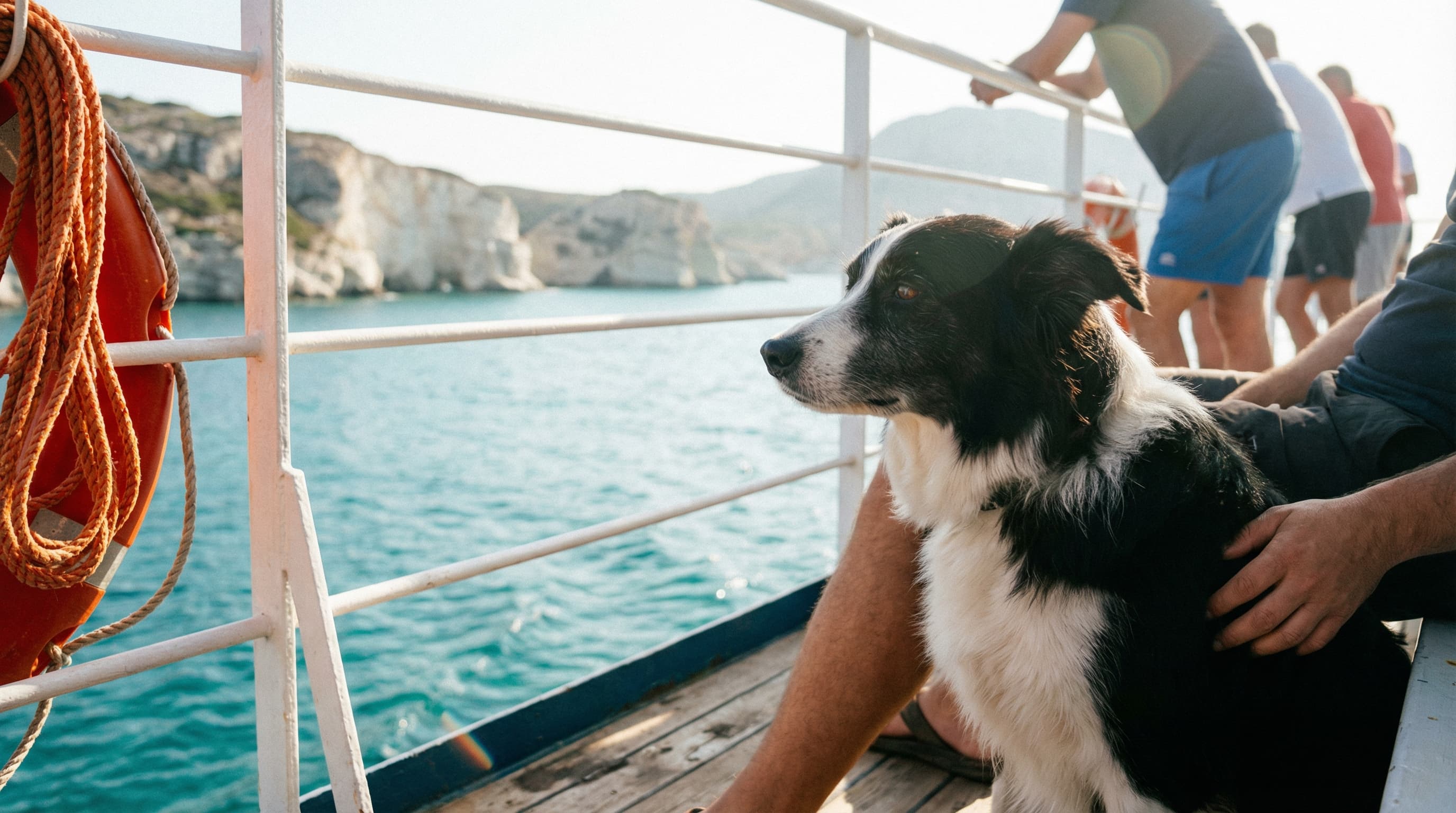
High-speed ferries (Seajets, Flying Dolphins): Only pets under 10 kg in carriers. €50 per pet per passage on Seajets. If you have a large dog, high-speed ferries aren't an option. Stick to conventional ferries, which take longer but accept dogs of any size.
Cost Breakdown
Dogs
| Microchip (if needed) | $25–$75 | ISO 15-digit, one-time |
| Rabies vaccine (if needed) | $15–$60 | Skip if active |
| Vet exam + EU health certificate | $100–$250 | USDA-accredited vet |
| USDA endorsement | $101 | Per certificate, no tests needed |
| Airline pet fee (cabin, each way) | $150–$200 | United $150, others vary |
| CDC Dog Import Form | Free | Online, for return trip |
| Total estimate (round trip) | $450–$1,000 | One dog, cabin travel |
Cats
| Microchip (if needed) | $25–$75 | Not needed for US re-entry, but worth the $25 |
| Rabies vaccine (if needed) | $15–$60 | Skip if active |
| Vet exam + EU health certificate | $100–$250 | USDA-accredited vet |
| USDA endorsement | $101 | Per certificate, no tests needed |
| Airline pet fee (cabin, each way) | $150–$200 | United $150, others vary |
| Total estimate (round trip) | $400–$900 | One cat, cabin travel |
Cats cost slightly less because there's no CDC Dog Import Form and no federal microchip rule for re-entry. The microchip is still worth getting. If your cat escapes the carrier at Athens Airport, a chip is the only way to prove it's yours.
Greece doesn't charge an inspection fee for routine pet entry checks at Greek airports, unlike Portugal's €42–85 fee.
Timeline
6+ months before (only if your pet needs a first rabies vaccine): Get the microchip implanted, then do the rabies shot. The 21-day waiting period starts the next day. If your pet already has an active rabies vaccine and microchip, skip to 3–4 weeks before.
3–4 weeks before: Confirm your airline's pet policy and reserve a pet spot. Policies change, especially on international routes. Call the airline directly. If you're island hopping, book pet-friendly ferry cabins now. They sell out fast in summer.
7–10 days before: Visit your USDA-accredited vet for the health exam and EU health certificate. The vet submits it through VEHCS for USDA endorsement. Budget 3–5 business days for the ink-signed original to come back by mail. This is the tightest window in the entire process.
1–7 days before (dogs only): Complete the CDC Dog Import Form online. Print the receipt or save it to your phone. Each dog needs a separate form.
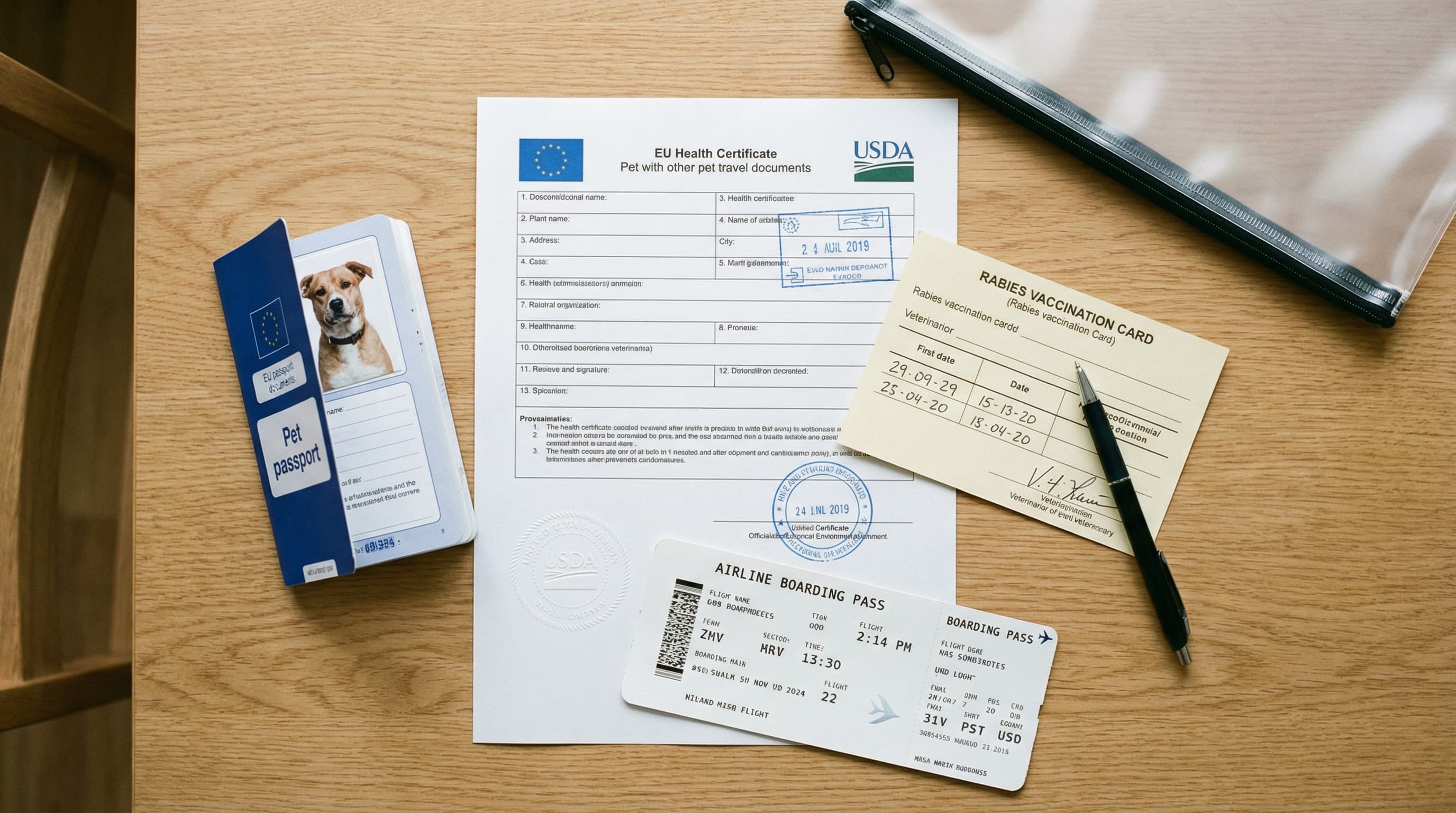
Travel day: Arrive at the airport 2–3 hours early. Bring the original endorsed health certificate, vaccination records, microchip paperwork, CDC Dog Import Form receipt (dogs), and your pet's regular vet records in a waterproof folder. The airline checks your paperwork at the counter before boarding.
Common Mistakes
Airport Tips
At your departure airport: Check in at the counter with your pet. You can't do this at a kiosk. Show the airline your endorsed health certificate, vaccination records, and (for dogs) your CDC Dog Import Form receipt. The agent confirms your pet reservation, checks carrier dimensions, and collects the pet fee.
At security, keep your pet in the carrier unless TSA asks you to remove them. If they do, take the pet out, hold it (use a harness and leash for cats), and send the empty carrier through the X-ray.
Arriving in Athens (ATH): Follow signs to customs after collecting your bags. Athens International Airport's Border Inspection Post handles veterinary checks in coordination with customs. A vet scans your pet's microchip, reviews the endorsed health certificate, and confirms vaccination records. If everything matches, the vet stamps your certificate "Entry Permitted" and you're through.
The process takes 15–30 minutes with correct paperwork. If you land outside regular hours, expect a longer wait. BIP contact for Athens: tel 210-3538455.
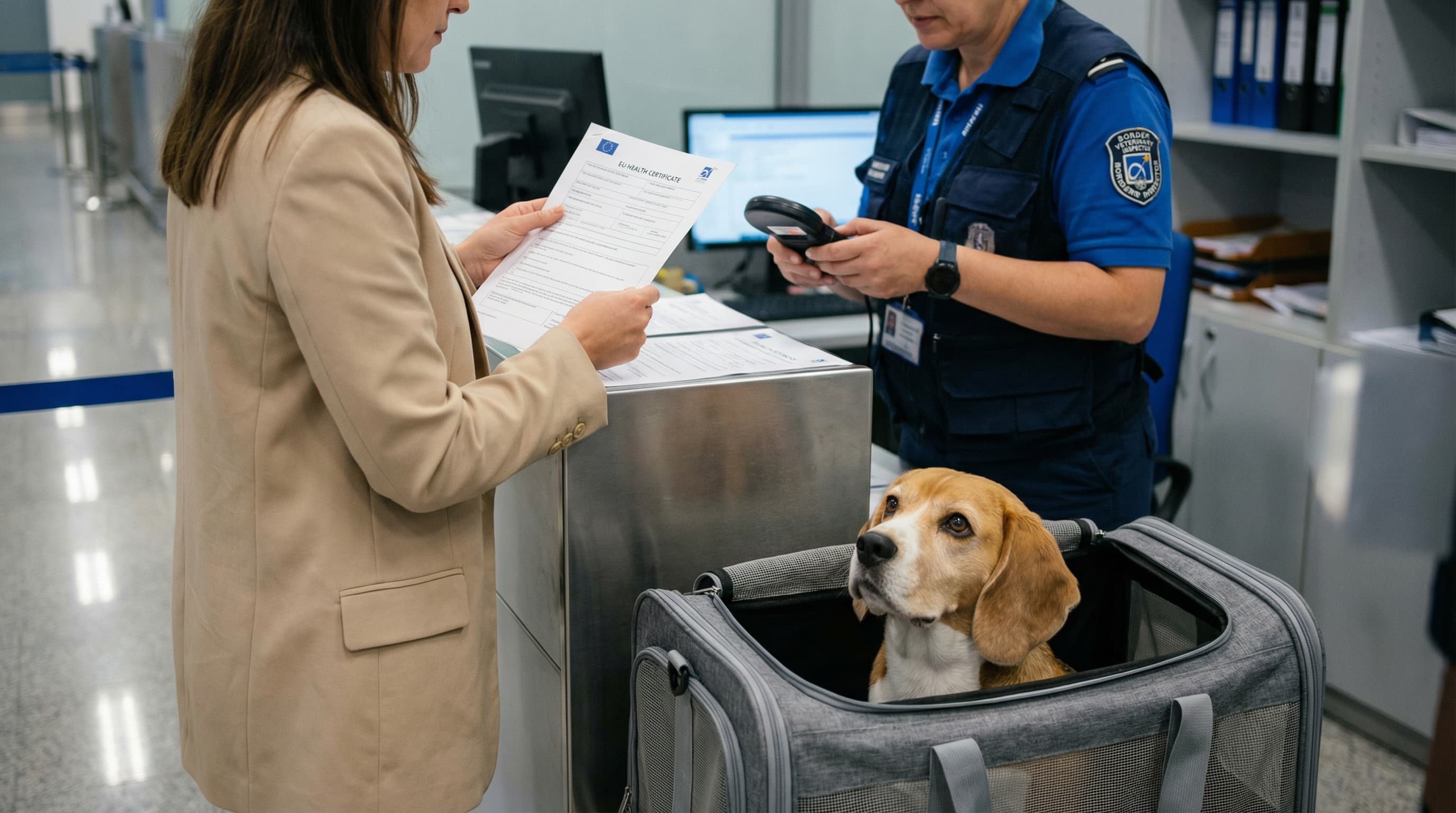
Arriving in Thessaloniki (SKG): Same process as Athens. Thessaloniki's BIP handles fewer international arrivals, so waits are typically shorter. BIP contact: tel 2310-475858.
Flying directly to an island: The same BIP check happens at island airports (Rhodes, Crete, Corfu, Kos, and others). The process is identical. These posts handle fewer arrivals, so the experience is often faster and more relaxed than Athens.
Cat-specific tip: At security, use a harness and leash when removing your cat from the carrier. A top-access carrier makes this much easier than pulling a stressed cat out the front opening while people behind you wait in line.
Returning to the US
Dogs
Greece is a low-risk rabies country according to the CDC. Re-entry rules for dogs from low-risk countries are simple:
- Complete the CDC Dog Import Form online before your return flight. The receipt is valid for 6 months.
- Your dog needs a microchip readable by a universal scanner.
- The dog must be at least 6 months old.
- At the border, your dog must appear healthy.
No screwworm certificate, no titer test, no USDA health certificate for the return trip. Greece is screwworm-free. You can land at any US airport. If you forget the CDC form, you'll be filling it out on your phone at the gate while your dog waits in the carrier. It takes about 10 minutes, but do it before travel day.
Show the CDC Dog Import Form receipt to your airline at check-in and to U.S. Customs on arrival.
Cats
Federal re-entry rules for cats are minimal. Your cat must appear healthy at the port of entry. That's the main federal rule.
There's no CDC import form for cats. No federal microchip rule. No screwworm certificate.
State rules may apply. Many US states need rabies vaccination for cats, and Hawaii quarantines all arriving cats. Check your home state's rules before you travel.
For the full re-entry process, see our guide to returning to the USA with a pet.

Your bottleneck is the USDA endorsement. Schedule the vet visit 7–10 days before your flight, submit through VEHCS right away, and leave time for the physical certificate to arrive by mail. Once the endorsed certificate is in your hands, Greece is one of the easier EU countries for pet travel — no advance notification email, no inspection fee, no tapeworm treatment, and direct access to the islands.